Why We're Building a Networking Agent, Not Another CRM
Your network is the most valuable asset you have. And right now, it's locked away from you.
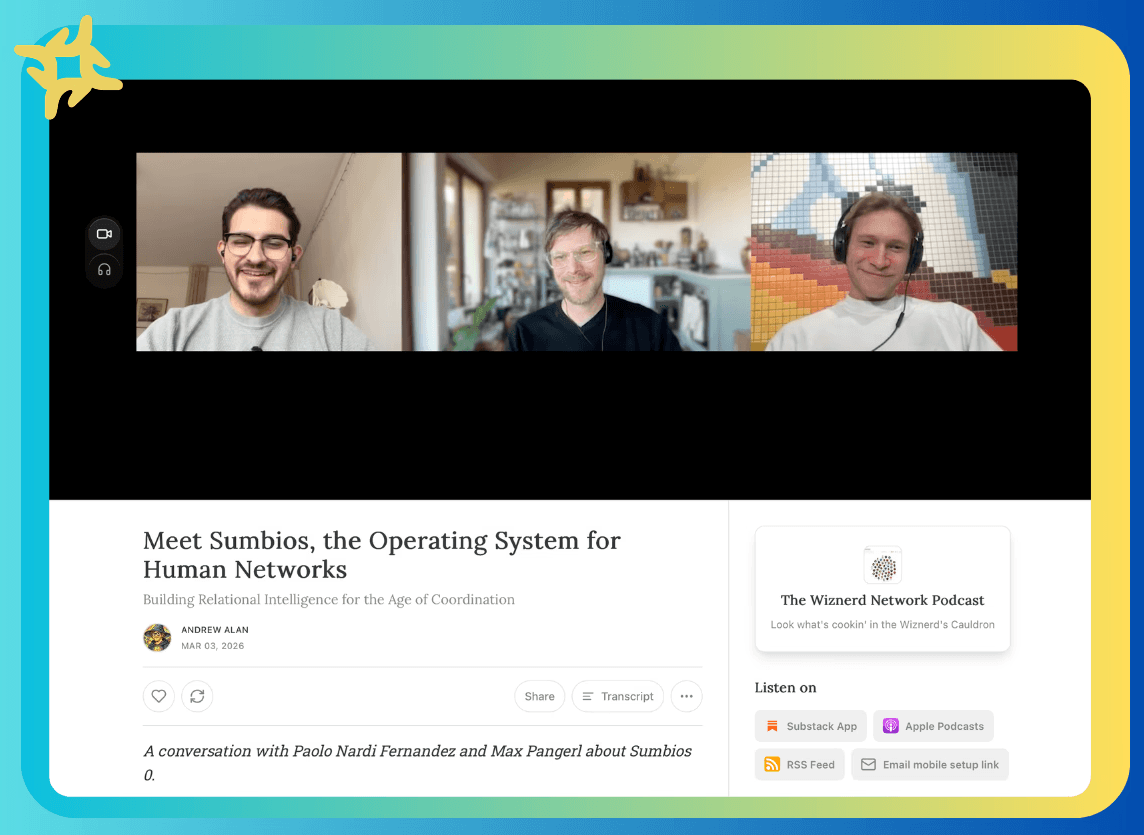
That's the line we keep coming back to. It's also the line that Andrew Alan, writing in his Substack Wiznerd.net, used to frame a long conversation he had with us recently about Sumbios, O, and why we're building what we're building. We want to take that conversation, shorten it, and tell it here — in our own voice — because the framing he captured matters to anyone thinking about relationship intelligence software, warm introductions, and what comes after LinkedIn.
The Problem: Your Professional Network Is Not Actually Yours
If you're a professional, your network is probably the single most compounding asset you've built over your career. Every conversation, every introduction, every colleague who became a client, every investor who became a friend — all of it lives somewhere. Mostly on LinkedIn. Some of it in your inbox. Some in a CRM nobody on your team remembers to update. And a lot of it in your head or some iPhone note.
The problem is that none of those places are designed to help you use your network.
You can't ask LinkedIn, "Who in my network has built a B2B SaaS company in the Nordics?" You can't ask it to surface the warm path to a specific fund partner through your shared connections. You can't ask it to remember what you and a prospect talked about eight months ago at a conference, or to flag when a key relationship has gone quiet.
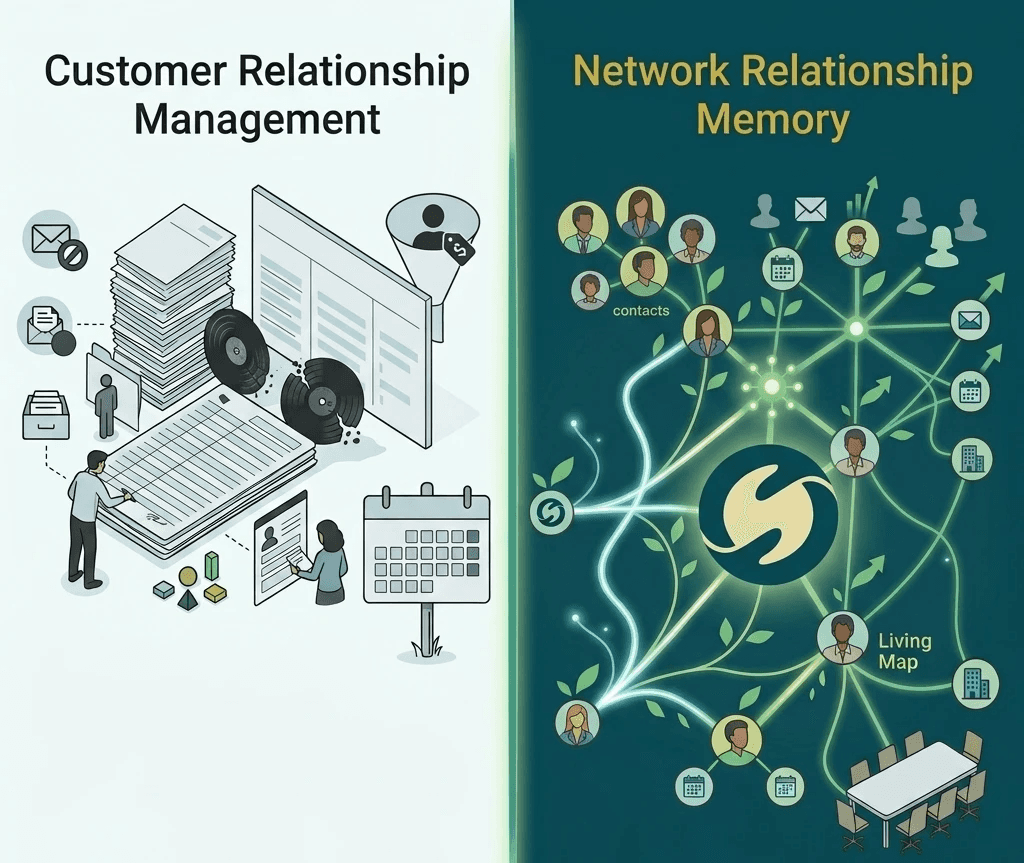
And you definitely can't ask your CRM. CRMs are filing cabinets. They capture what already happened. They don't tell you who to talk to next, and they don't remember the texture of your relationships.
This is the gap we set out to close with O — our AI networking agent.
What Is a Networking Agent?
A networking agent is a new category of software, and we're defining it on purpose. The term matters because the alternatives — CRM, contact manager, relationship intelligence platform — all imply that your network is a database to be maintained. That framing is wrong.
Your network is alive. It has memory, signals, context, and direction. A networking agent is software that treats it that way. Specifically, a networking agent:
Maps warm introduction paths through your shared network.
Remembers every relationship — every note, every conversation, every signal, with zero hallucinations
Monitors signals — job changes, funding rounds, hiring surges, new mandates — so you know what's happening inside your network before it's public
Organises your relationships into circles — the groups that actually matter to you, whether that's portfolio founders, target accounts, community members, or warm investors
Does deep research on any contact in under sixty seconds — so you walk into every meeting already holding the full picture
If you searched for "what is a networking agent" and landed here, that's the short answer. It's the category. We wrote about it in more detail in a recent article here, but the definition matters first.
A networking agent is not a CRM. It's not an automation tool. It's not Clay. It's the layer that sits between you and your network and makes it legible, searchable, and actionable — without you having to maintain it.
Why We Started Sumbios
Three years ago, the two of us — Paolo Nardi Fernandez, our CEO, and Maximilian Pangerl, our CRO — were sitting on a couch talking about life, relationships, and memory. The conversation kept circling back to the same observation: the most important thing any of us have is the people around us, and the tools we use to stay connected to those people are actively working against us.
The name Sumbios comes from the ancient Greek root of symbiosis. It's a deliberate choice. We believe professional life is relational, and software for professional life should reflect that.
Paolo's background is in computer science, sustainability innovation, and digital ethics. Max's background is in renewable energy, circular economies, and entrepreneurship. We both studied leadership for sustainability in Malmö, where Sumbios AB is now headquartered. That shared grounding shows up in how we think about data: your relationships belong to you, not to the platform.
A Tour of Sumbios O
Andrews article walked through a live demo of the product. Here's what he saw, in his words:
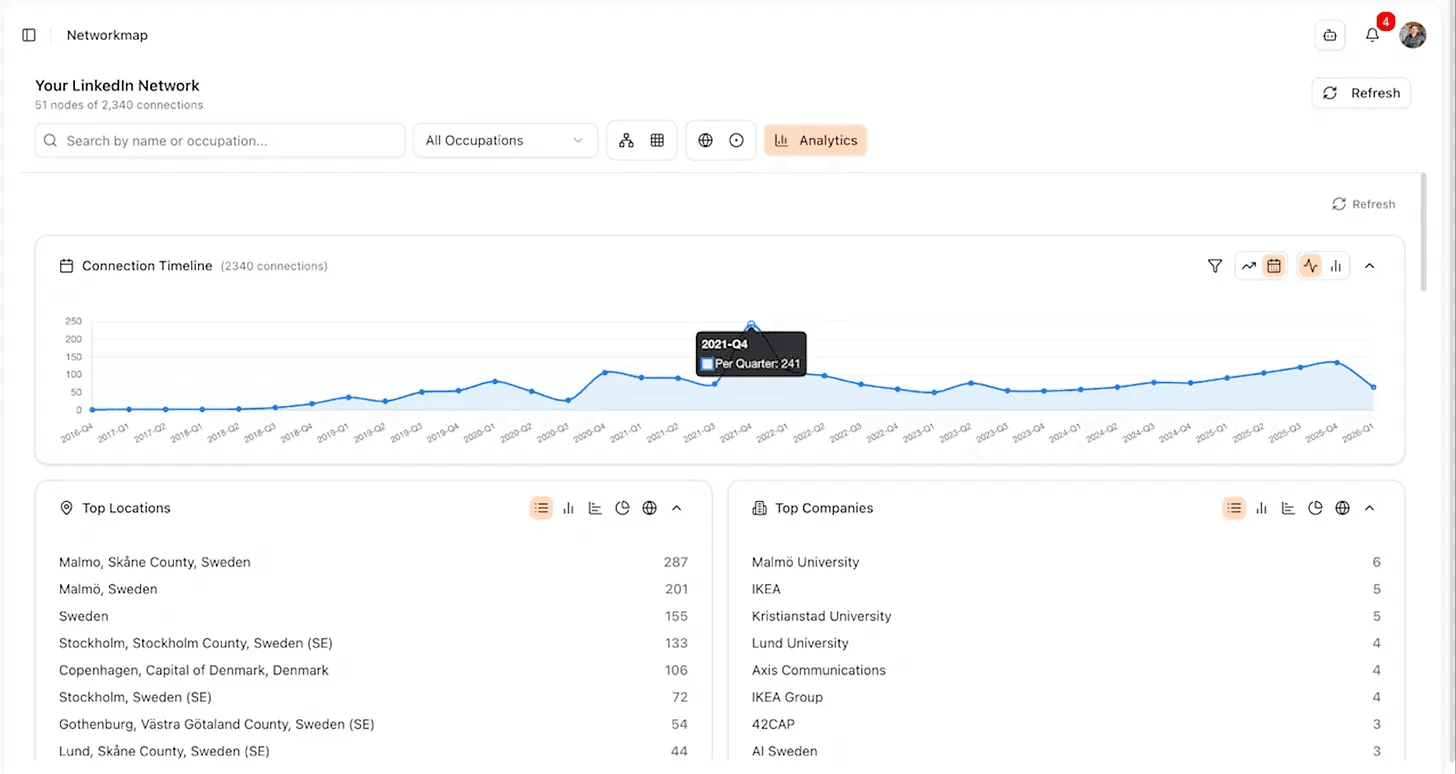
Network visualisation you actually control
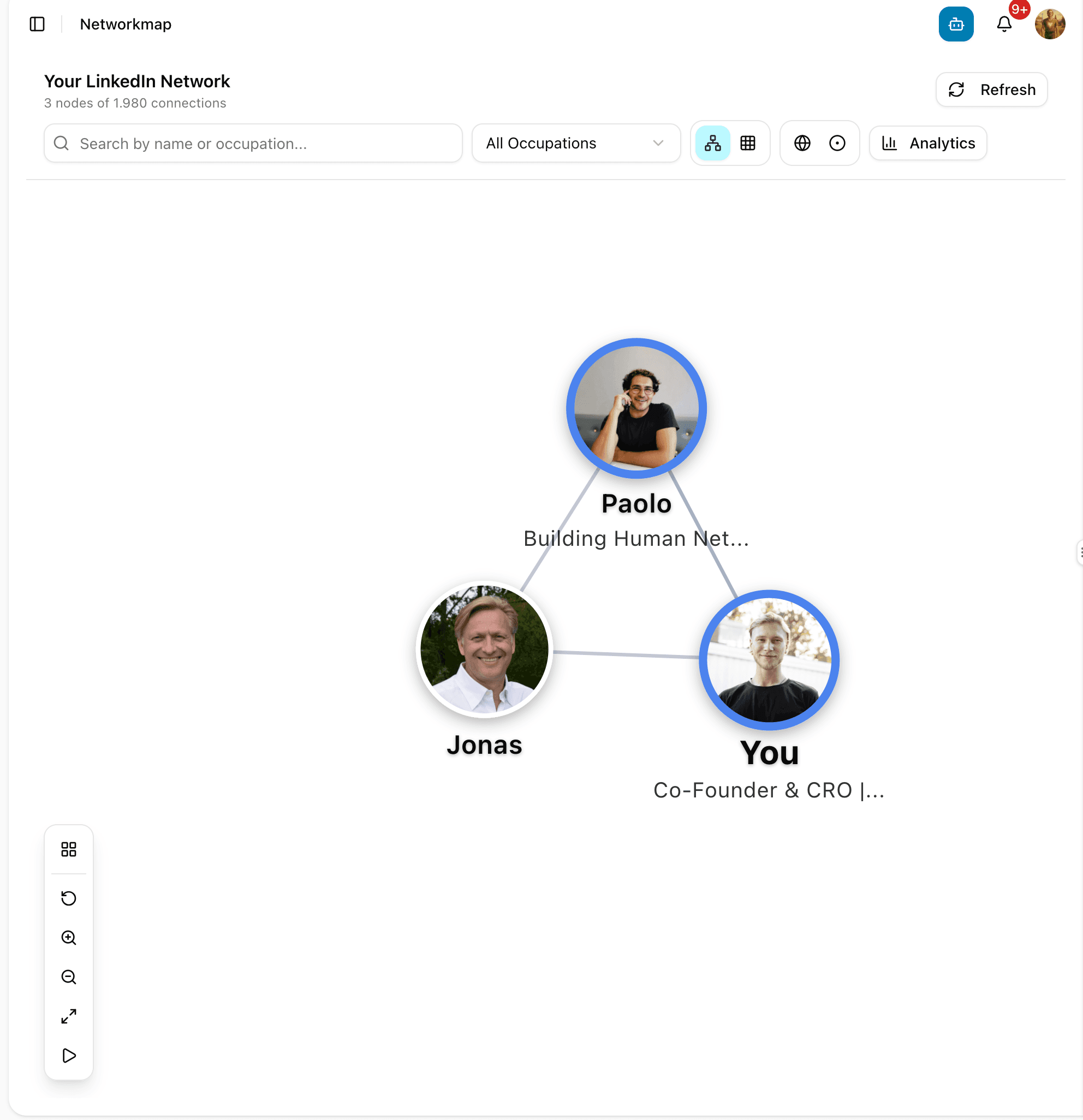
O lets you see your network through lenses that matter: industry, company, skills, seniority, employment type, location. The AI layer makes all of it searchable in plain language, viewable as a list or as a living network graph. You can look at your connection timeline — when relationships formed, how your network shaped itself year by year — and trace the story of your professional life through the shape of it.
Andrew put it well: "Our networks tell a story." O makes that story visible.
A relationship journal that becomes relationship memory
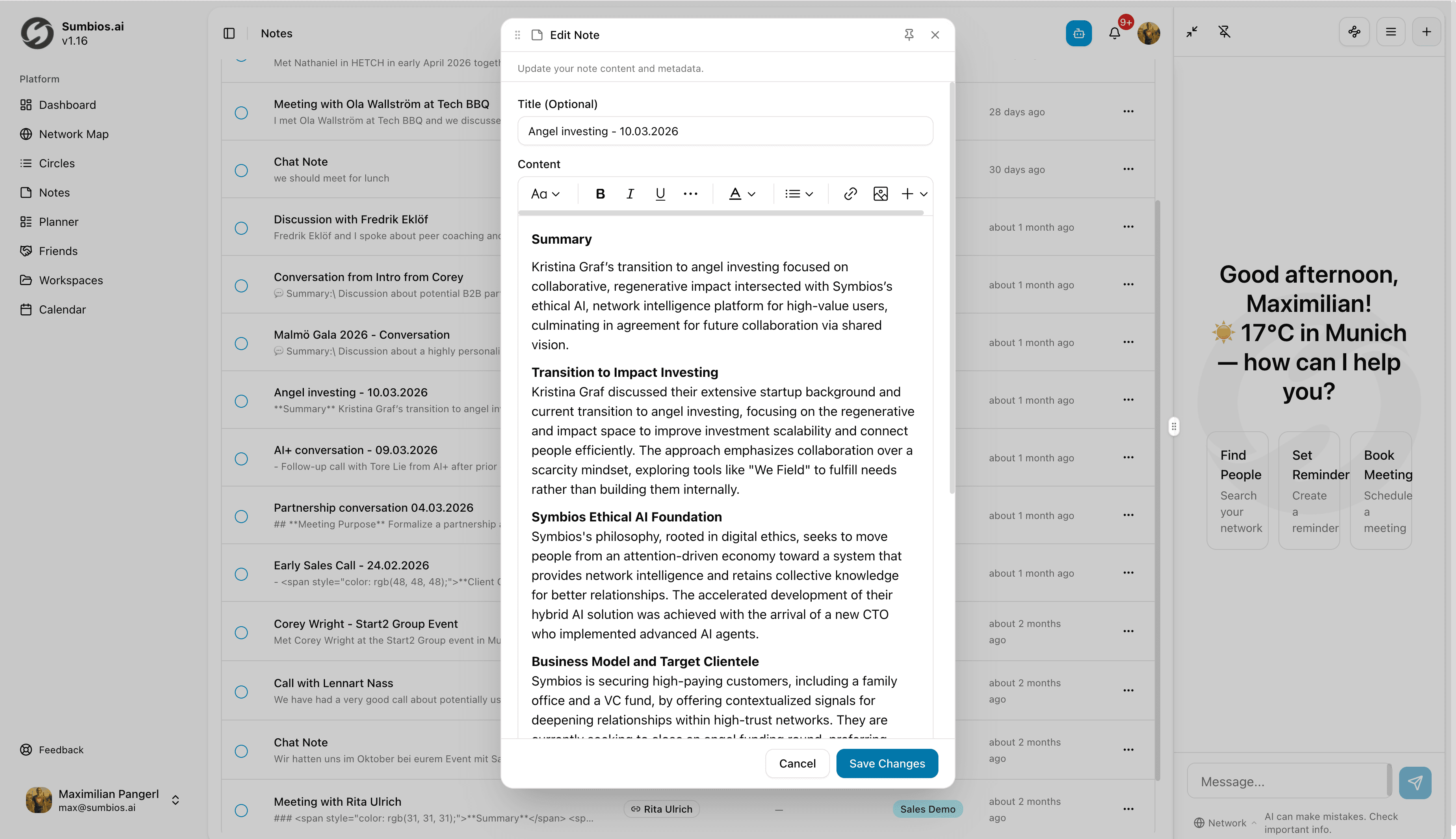
For any contact, you can add notes. Not just job title and phone number — the actual context: what you talked about, what project they're working on, what you wanted to follow up on. All of that becomes searchable. It becomes the relational journal you wish you'd been keeping for the last ten years.
This is where relationship memory starts mattering. Because once the journal exists, O can act on it: remind you to follow up, surface relevant contacts when you're preparing for a meeting, flag when a relationship has gone quiet. We're integrating email, calendar, and other platforms so the memory builds automatically over time — without you having to manually enter anything.
Circles for the networks within your network
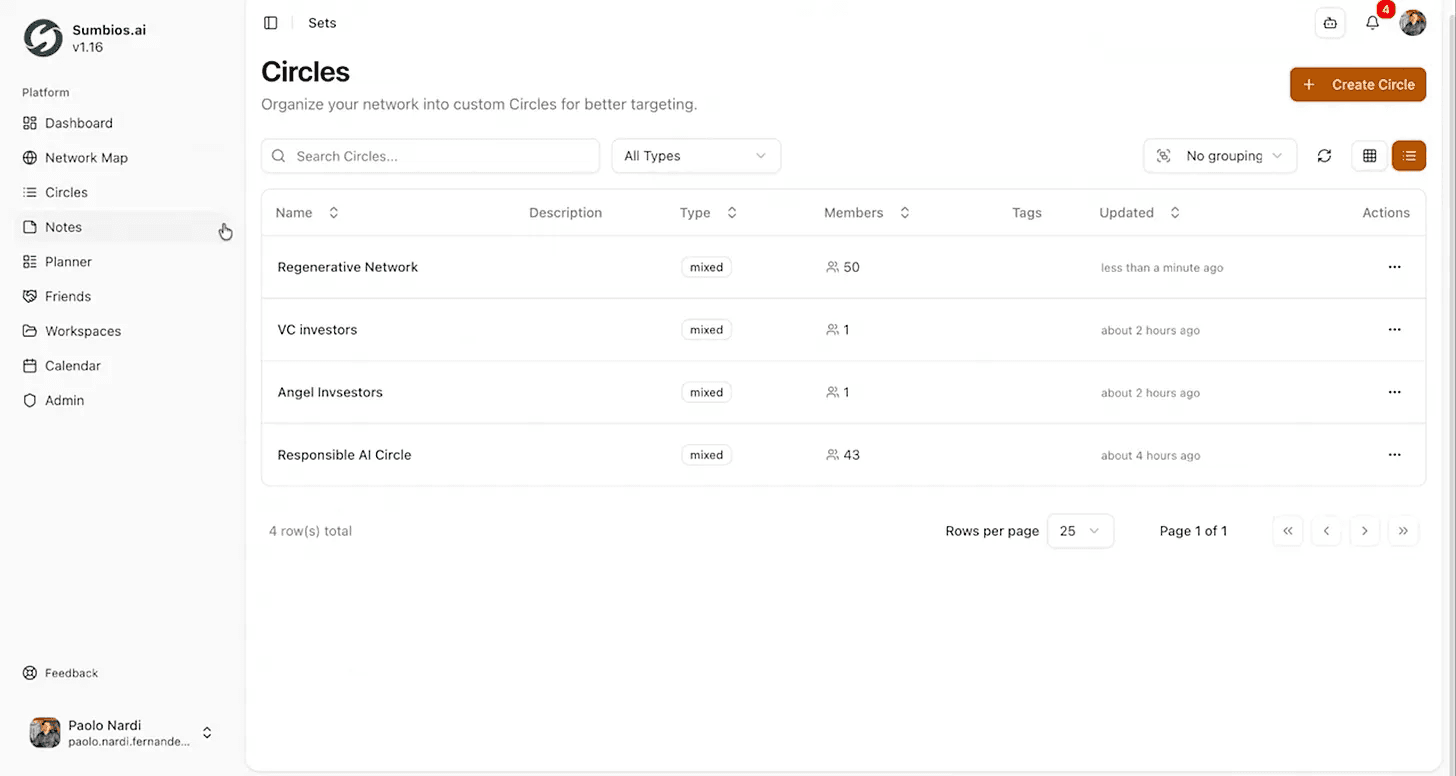
Your network isn't one thing. It's many overlapping communities: newsletter subscribers, potential investors, portfolio founders, people you've actually met in person, people you accepted a connection request from and couldn't place a week later. Circles let you group your contacts into the ecosystems that mean something to you.
That distinction — met in person vs. pure online connection — was the one Ben said resonated most. We agree. Most of the value in your network lives in the people you actually know.
Collective Networks — where warm introductions get real
This is the feature that solves what LinkedIn can't. On Sumbios, you can choose to share your network with trusted people — co-founders, investors, team members, friends. When you do, their network becomes searchable for you, and yours for them.
Suddenly, "who's the warmest path to this fund partner?" has an answer. Not a speculative second-degree guess. A real one — through a shared contact you both trust.
Missions — from mapping your network to activating it
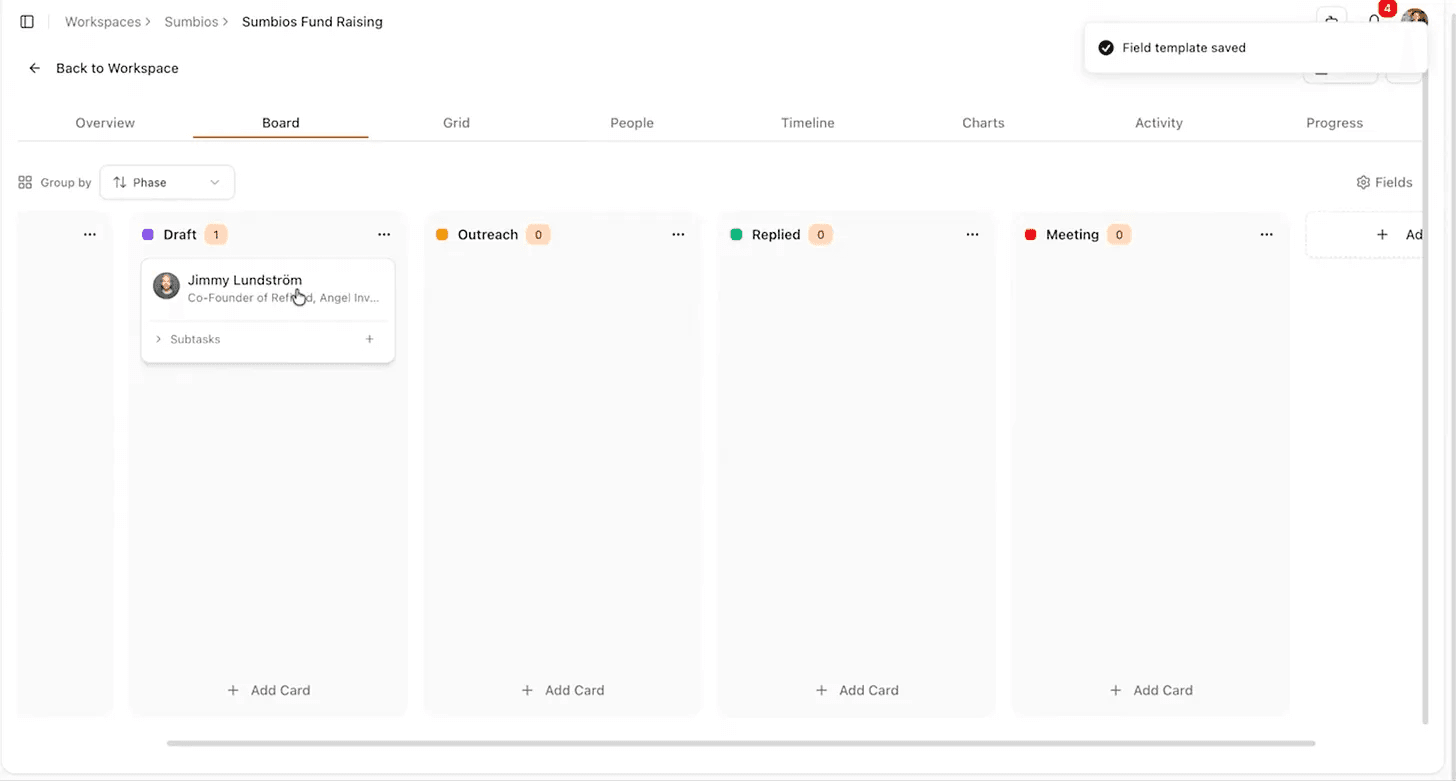
Missions is the layer where the map becomes action. You define a goal — raising a round, building a team, landing a partnership — and O continuously recommends people from your and your friends' networks who might help. You track outreach, add fields, set reminders, move contacts through stages like cards on a board.
This is where Sumbios stops being a map and becomes an assistant.
Why the Existing Tools Don't Do This
The honest answer is that they can't, because their business model won't let them.
LinkedIn's business is attention and retention. Their feed is optimised to keep you scrolling. Helping you quickly find the right person and leave the platform would undermine the entire economics of the product.
CRMs like Affinity and Attio are structurally closer to what a networking agent does, but they come from a different direction. They're built for teams to manage pipelines. They assume someone will enter the data. They don't have relationship memory, they don't map warm paths proactively, and they don't treat your network as something that compounds. They treat it as rows.
Paolo said it clearly in the interview: "We're a coordination layer, not an extraction layer."
That's the difference.
Data Sovereignty Is Not a Feature. It's the Foundation.
Everything on Sumbios is hosted and stored in the EU. Your data is encrypted end to end.
If you want to leave, you can. Every circle, every contact list, every note — you can export it to CSV or Markdown with one click. We believe portability isn't a feature, it's a precondition for trust.
This matters because the whole point of a networking agent is that it knows a lot about you and the people around you. That's intimate data. We've designed the architecture around the assumption that you'd never trust us with it if we designed it any other way.
Who O Is For
We built O for four kinds of people who live or die by their networks:
Investors, VCs, accelerators, and family offices — where proprietary deal flow and warm paths to founders are the whole game
Sales and BD teams — where the difference between a warm intro and a cold email is the difference between a €1M contract and a no-reply
Executives and C-level operators — who need to know where their market is moving before it moves
Ecosystem builders — who nurture communities and whose reputation compounds through the introductions they make
If you're in one of those groups, we built O for you. If you're curious about how it works for your specific use case, our investor, sales, executive, and ecosystem pages go deeper.
The Bigger Idea
The thing that makes this moment different is that AI finally makes it possible to treat relationships the way they deserve to be treated — as a living, searchable, memory-enabled asset — without the person at the centre having to do the maintenance work.
That's the category we're building. Not another CRM. Not another contact manager. A networking agent: software that turns your network from a static list of names into an operating system for everything you're trying to build through people.
Max put it best in the conversation with Andrew: "We're building this with intention, not just for attention."
Read the Full Interview
We're grateful to Andrew for the thoughtful, detailed write-up. His original piece is worth reading in full — it goes deeper on the demo, the philosophy, and what he saw when he spent an hour inside the product with us.
👉 Meet Sumbios: The Operating System for Your Network — Wiznerd.net
Sumbios is building O, the AI networking agent that finds warm introduction paths through your network, builds relationship memory, and tracks the signals that matter. Based in Malmö, Sweden. Join the second cohort of users at sumbios.ai.