What Is a Networking Agent?
Most professionals have had thousands of meaningful conversations and connections over the course of their careers. Yet, how many of them do they really remember that may be relevant today?
The names, the timing, the reasons someone mattered - dissolve quietly across inboxes, calendars, and tools that were never designed to hold relationships. Not because people don't care. Because no system was built to remember on their behalf.
A networking agent changes that.
A networking agent is an AI-driven relational intelligence system that makes your professional network remember, think, and act with you.
It sits above your existing tools, email, calendar, notes, CRM, and creates a persistent, navigable memory of your network. Not a database you maintain. A living context layer that works invisibly in the background, compounding in value with every interaction.
The shift it represents is structural. We are moving from a model of professional relationship management that depends on manual tracking - logging meetings, updating status fields, setting contextless reminders to one that runs on memory, context, and coordinated execution. From overhead to intelligence. From maintenance to continuity.
This is not an incremental improvement to the CRM. It is a different paradigm.
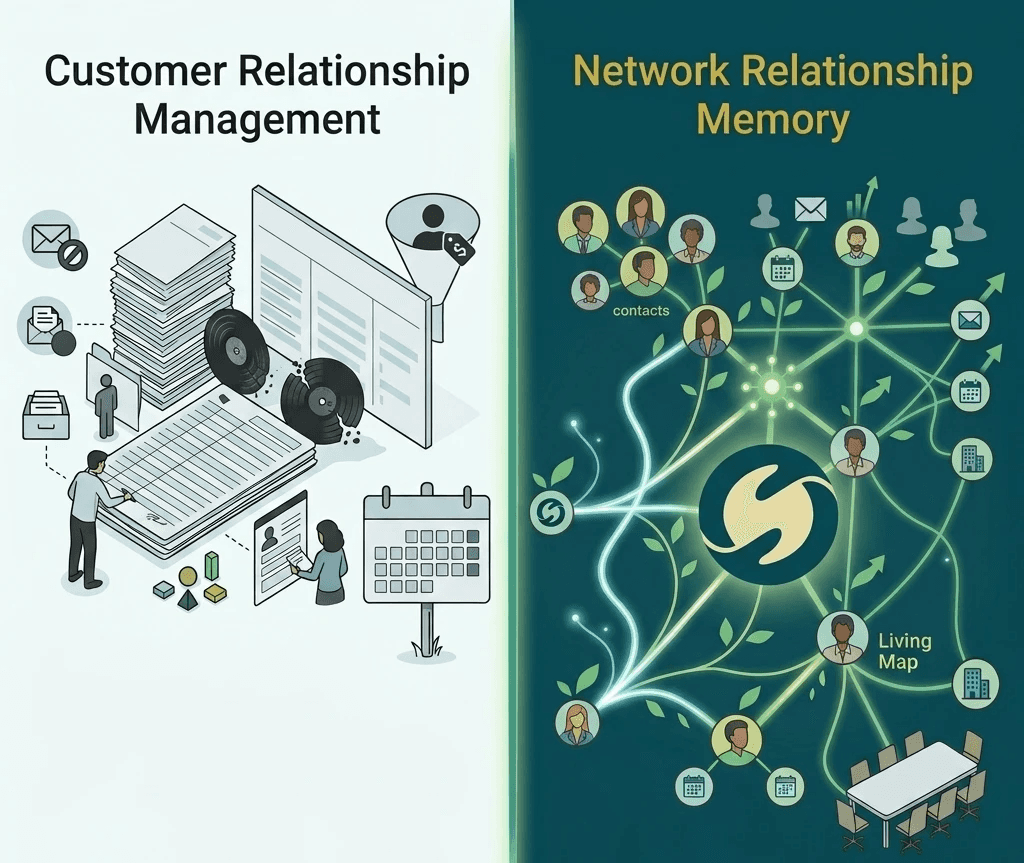
Why a Networking Agent Is Not a CRM
Before we explain how a networking agent works, it is worth being precise about what it replaces and what it does not.
A CRM was built for pipelines. It tracks deals, stages, and handoffs. It requires someone to manually log every meeting, update every field, and remember to set every follow-up. For decades, this was the best available infrastructure for professional relationships. It was also built for a transactional model of work, not a relational one.
A networking agent does not replace your CRM. It sits above it. Where a CRM records what you tell it, a networking agent remembers what actually happened across email, calendar, and every conversation surface you already use. Where a CRM requires you to search, a networking agent surfaces what matters before you ask. Where a CRM manages a pipeline, a networking agent activates a network.
The distinction matters because relationship intelligence software has evolved. Tools like Affinity and Attio have brought CRMs closer to relational workflows. But the architecture remains the same: a database that depends on human input and organises around deals, not people. A networking agent starts from a fundamentally different premise, that the network itself is the asset, and the system's job is to make it visible, navigable, and alive.
How a Networking Agent Works
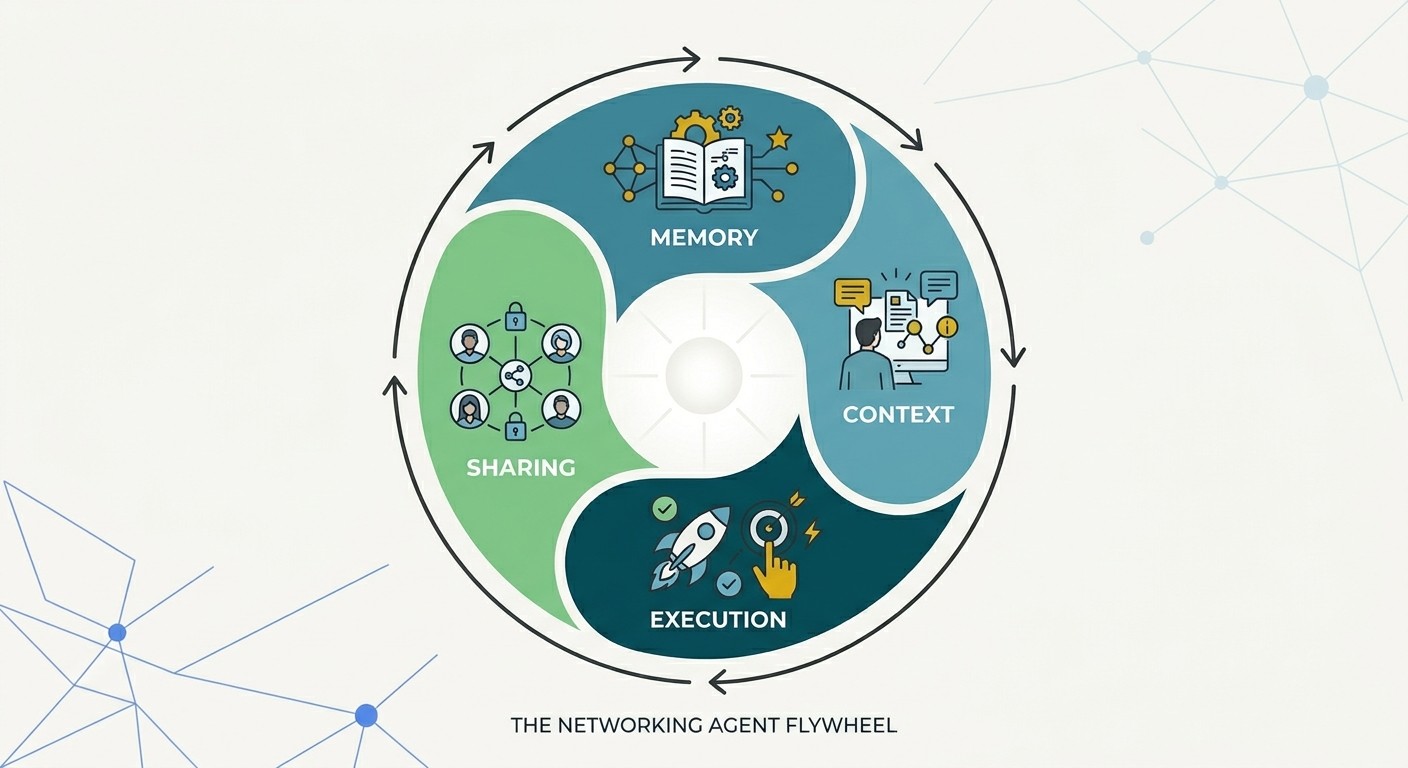
The architecture of a networking agent rests on four mechanisms. Each one addresses a specific failure in how professionals manage relationships today, and each one builds on the others.
1. Memory
A networking agent automatically builds a dynamic relationship memory without administrative overhead.
By integrating with the communication tools you already use, the agent silently ingests and retains relationship history. It remembers who you met, when you met them, and what was discussed. No manual data entry. No forgetting.
This is important not because memory is a feature, but because memory is where value compounds. A relationship without continuity is just a contact. A contact without context is just a name. Most professionals today are operating with thousands of names and almost no continuity. The networking agent closes that gap, structurally, not heroically.
For investors managing portfolio relationships across years of deal flow, this changes everything. A networking agent for investors means never losing the thread of a conversation that started three funds ago and never walking into a board meeting without the full history of every relationship in the room.
2. Context
Memory alone is not enough. Intelligence emerges when context travels with you across workflows and time, adapted to your current intent.
The networking agent proactively prepares you for interactions. Before a meeting begins, it surfaces relationship history, shared connections, and recent career signals. Instead of a generic calendar notification, it delivers a context-linked brief that carries the original notes and reasons for the conversation. You never walk into a room without knowing why you are there and what matters to the person across the table.
This is the difference between having data and having intelligence. Data sits in a tool. Intelligence arrives when you need it, shaped by what you are trying to do.
3. Execution
A networking agent does not stop at remembering and preparing. It acts while leaving the final decisions to human judgment.
It continuously monitors your network for meaningful signals: career transitions, strategic announcements, funding rounds, role changes. It surfaces the right moment to reach out, not just that time has passed since your last interaction. It maps the shortest warm path to someone you need to reach, the warm introduction that turns a cold outreach into a trusted conversation. It runs deep research on individuals and companies, turning latent network data into coordinated action.
The warm introduction is where most networking tools fail. Finding someone is easy. Reaching them through a trusted chain of relationships, where every person in the path has context on why the introduction matters, is the problem no CRM has ever solved. A networking agent maps these warm paths automatically, across your extended network, and tells you exactly who to ask and why.
The important principle here: the agent executes, but you decide. Autonomy without authority. This is what makes the system trustworthy enough to rely on daily — it removes the cognitive overhead of relationship management without removing the human from the relationship.
4. Sharing
This is where the architecture becomes genuinely different from anything else on the market.
A networking agent built on real trust infrastructure enables collective network visibility without shared exposure. It works in two ways.
The first is permissioned warm introductions. If you need to reach a specific person, the agent can search a collaborator's network, surface a ranked shortlist for them to review, and draft a contextual introduction, all without the collaborator ever exposing their full contact list. The person who holds the relationship makes the final call. The agent does the matching. Trust is preserved at every step.
The second is shared network intelligence. Teams, investors, and ecosystem builders can choose to share visibility across their networks with trusted partners, not to hand over contacts, but to understand the totality of their collective connections. When a team can see the full shape of who they know together, they make better coordinated decisions: who to approach, where the gaps are, which relationships to nurture. This is the difference between a group of individuals with separate address books and an organisation that understands its relational capital as a shared asset.
Both modes rest on the same principle: you control what you share, with whom, and on what terms. Nothing is exposed without permission. Nothing is extracted without consent. Collective intelligence becomes possible precisely because ownership is never compromised.
This is not open networking. It is permissioned coordination, the kind that only works when the infrastructure is designed for trust from the beginning.
What Changes When a Network Has Memory
The legacy model of professional networking was built for a transactional world. You met someone. You logged them in a spreadsheet or a CRM. You set a reminder. You hoped you would remember why they mattered when the reminder fired.
A networking agent collapses that entire model. It replaces isolated rows and pipelines with a cohesive, privacy-first system built to nurture genuine connection. Relationships compound over time — but only when continuity is preserved. The networking agent is the infrastructure that makes that compounding possible.
What emerges is not just efficiency. It is a different quality of professional life, one where your network is visible, navigable, and alive. Where the right warm introduction happens because the context was there, not because someone remembered to make a spreadsheet. Where teams coordinate through trusted channels instead of guessing who knows whom. Where network activation is not a manual exercise in scrolling through contacts, but an intelligent, continuous process that runs in the background of your work.
This is what AI networking was always supposed to look like, not a faster search engine for people, but a system that holds the memory and context of every relationship and helps you act on it with care.
This Is What We Are Building
At Sumbios, we are building the trusted coordination layer for human intelligence, starting with O, a networking agent that remembers everyone you know, finds the warm path to anyone you need to reach, and helps you and your team activate your network together.
Not a smarter CRM. Not another AI wrapper. Not a tool that treats your relationships as data to be extracted. A system that treats your network as a living asset, governed by trust, anchored in European values, and designed to compound in value over time.
Your network already holds the answers. The question is whether any system is built to remember them.