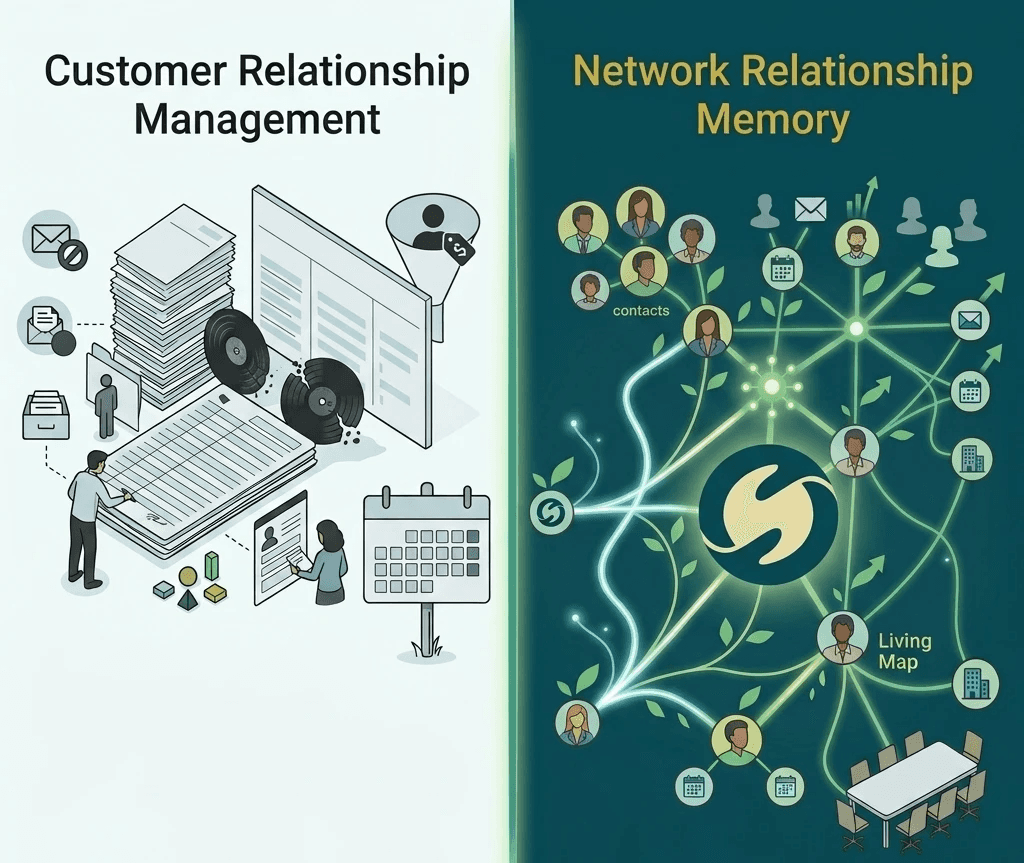
The CRM has ended
It was built for a transactional model of professional life.
Someone entered your network. You logged the meeting. Added a note. Set a reminder. Checked a status field. Moved a card across a board. The system filled with rows, queues, and manual workflows — all designed to answer a single question: what do I need to do next, and when?
That ceremony came from real constraints. Relationship context was fragile. It lived in inboxes, in fading memory, in conversations that never made it into any system at all. Teams needed a way to track it. So they built tracking systems.
But tracking is not intelligence. And over time, the overhead of maintenance consumed the thing it was supposed to protect.
The update became the work. The record became the relationship. And somewhere between the data entry and the dashboard, the actual human connection — the trust, the context, the moment — got lost.
The shift that changes everything
Linear recently described a version of this for software development. Issue tracking, they argued, was built for a handoff model — PM scopes the work, engineer picks it up, the system fills with prioritisation, negotiation, and status checks to bridge the gap. Teams didn't gather around a Kanban board because they loved the process. They did it because they had no better way to answer: what's the status? who's responsible? what's next?
Agents collapse that model. Instead of checking the board, you ask: what's the status of the authentication bug? Can you debug this? What should the team focus on today? The system stops being a record you maintain and becomes a context layer you work from.
The same shift is happening to relationships.
Today, professionals check a CRM to answer: when did we last speak? who owns this relationship? when should I reach out? They move contacts across pipeline stages. They log calls manually. They set reminders that arrive without context. They spend hours every week on relationship admin — not because they want to, but because there has been no better primitive.
That primitive now exists.
Instead of checking the record, you ask: what's the status of this conversation? when should I reach out to Thomas next? someone new has enquired about my services — who are they and what do I need to know? The system stops being a database you update and becomes a memory layer that works for you.
This is not a better CRM. This is the end of the CRM model.
From transactional records to systems of memory
The CRM era was built on three assumptions: that relationships could be captured in fields, that status could be tracked in stages, and that the overhead of maintenance was an acceptable price for the visibility it created.
All three assumptions are now obsolete.
The next era is built on something different: memory, continuity, signals, and intent.
Not records. Not reminders. Not pipelines.
A system that remembers everything that matters — across conversations, meetings, documents, and tools — without you having to tell it what to remember. That surfaces the right context at the right moment, automatically, based on what you are trying to do. That monitors your network for signals that matter — career moves, new connections, changing circumstances — and surfaces the moment to act, before you think to ask. That works in the background, invisibly, so the relationship gets your full attention and the system gets none of it.
This is the shift. From overhead to intelligence. From maintenance to memory. From tracking to orchestration.
What O is becoming
O is your networking agent — the first system built natively for this model.
Not a CRM you update. An agent that works with you. In the background, across your tools, across your contexts, across your network — capturing what matters, remembering what was said, surfacing what is relevant, and acting when the moment is right.
Memory that compounds. O holds your full relational context — meetings, notes, documents, signals, conversations — and makes it instantly navigable. Ask what you need. O knows.
Signals without the monitoring. O watches your network for you. Career transitions. New connections. Engagement moments. It surfaces the right signal at the right time, tied to what you are actually working on — not a generic alert buried in a feed.
Context that travels with you. Across professional networks, documents, collective networks, and trusted teams. O reasons across all of it — finding warm paths, matching needs, surfacing blind spots no single person could see alone.
An agent that adapts to your intent. What matters changes — day to day, week to week, mission to mission. O is customisable around your current context, not locked to a fixed view of your world. The agent reconfigures around what you are trying to do, not around what you last told it to track.
Privacy by design. Shared intelligence without shared exposure. You choose what O can see, what your team can access, and what stays yours. Trust is the infrastructure, not an afterthought.
Orchestration, not overhead. O sits above your tools — not between them. It does not replace your email, your calendar, or your CRM. It unifies the intelligence across all of them, so you stop switching and start thinking.
What we just shipped
The latest release moves O meaningfully toward this vision.
Unified chat and context scoping. One surface. Scope your conversation to any Workspace or Mission directly from the chat header. The agent works from your full context — not a page you have to navigate to.
Silent memory enrichment. O now searches your notes and saved knowledge automatically, in parallel with every query. You do not have to ask. When O surfaces an answer, it cites what it found from your own memory. This is the difference between a search tool and an agent that actually knows you.
Network-scoped intelligence. Global search and chat now operate across the full coherent scope of your network. What you ask, O answers — from the full depth of what it knows about your relationships.
A faster, more stable intelligence layer. Upgraded model stability, a more natural and direct orchestrator, and Serper integrated as an additional web search engine — the highest-quality Google search available, at the lowest cost. The neural re-ranker now loads lazily, improving performance without sacrificing result quality.
Chat that scales with you. Background threading, graceful error handling, and infrastructure built to grow with your network.
What is coming next
Company-level deep research. Context-linked recall that carries the note it was born from — not a generic ping, but a nudge that knows why it matters. An inquisitive agent intake that configures your first missions through conversation, not forms. And the full five agent moments — recall, pathfinding, preparation, follow-through, signal — felt within the first 48 hours.
The networking agent is Phase 1. The operating system for human networks is where it leads.
CRM was built for records.
O turns relational memory into coordinated action.
We are building toward that future with the professionals already living inside it.