"We never use our customers' data to train third-party AI models. Every data flow is designed to be auditable."
That's the line our CRO and co-founder, Maximilian Pangerl, opened with when Joana Belo Pereira sat down with him for what was meant to be a thirty-minute demo of Sumbios O — and turned into the opening interview for her new publication, House of European Tech.
Joana published the piece under the title How European social media is redefining professional relationships, and it captures something thats deep in our ethos: that the way we build relationship intelligence software in Europe has to be structurally different from how it's been built in the US, because the assumptions about data, privacy, and trust are different from the foundation up.
This is the Sumbios version of that conversation.
The Vision: Networks as Infrastructure, Not as a Feed
Most professional networking platforms today are designed to maximise time-on-platform. Their underlying business model is advertising or subscription revenue from your continued attention. That model shapes every product decision: what gets ranked in your feed, what gets surfaced when you search, what features get built, what doesn't.
The features you actually want, like "who in my network has experience with X, who can warm-introduce me to Y, when did this relationship go quiet?" - don't get built, because they would let you achieve your goal and leave.
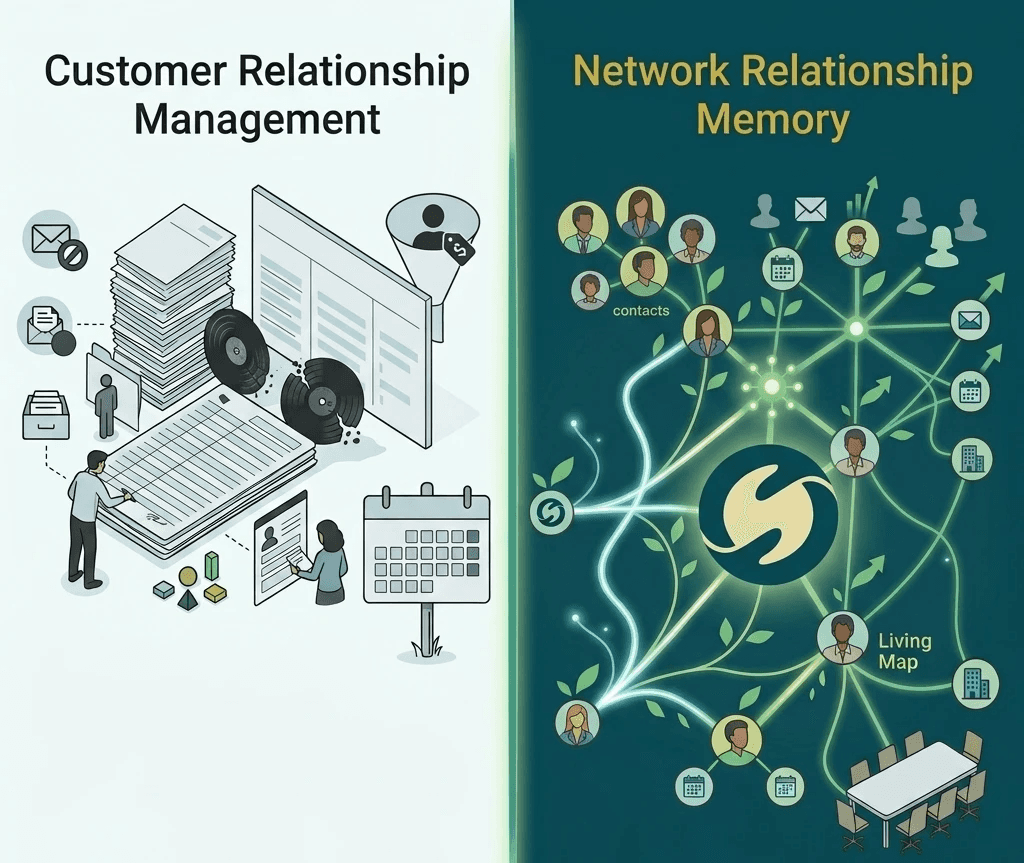
Sumbios is built on the opposite premise. We're betting on networks as infrastructure: a layer that sits underneath your professional life and helps you achieve outcomes through your existing relationships, faster. We call this layer the Symbiotic Intelligence Engine. It's the relational infrastructure that powers our AI networking agent, O.
The product is built for the four roles where relationships are the difference between a great year and a wasted one: investors and accelerators, sales and BD leaders, executives, and community builders. Each of these roles is heavily relationship-dependent. None of them is well served by what LinkedIn, Sales Navigator, or traditional CRMs deliver today.
A European Alternative to LinkedIn — and the 2020s Version of Sales Navigator
Joana framed Sumbios in her piece as "simultaneously a European alternative to Microsoft's LinkedIn, as well as the 2020s version of everything LinkedIn's Sales Navigator has ever tried (and failed) to pull off."
LinkedIn solved the problem of finding professional contacts. It hasn't solved — and given its business model, can't solve — the harder problem: utilizing the network you've built effectively. Sales Navigator was supposed to bridge that gap. It hasn't, because it sits on top of the same data architecture that's optimised for ads and engagement, not outcomes and deep connection.
A networking agent like O is what gets built when you start the architecture over with a different goal. The job to be done isn't keeping you on the platform. It's getting you to your next warm introduction faster, with the right context, before the window closes.
That changes everything about how the system is structured: from the data model, to the AI layer, to where the data is physically stored.
The Memorable Feature: Sharing Your Entire Network
Joana wrote that the feature that stood out most when she audited O was the ability to share your entire network with someone else.
We agree. And we built it that way deliberately. On LinkedIn, when you need a warm introduction to a target contact, you have to find the mutual connection yourself, message them, hope they reply in time, and hope they're willing to make the intro. By the time the chain completes, the window has often closed.
On Sumbios, when you and a trusted collaborator share networks, the system maps the shortest warm path between you and any target contact in either of your combined networks, automatically, and with the relevant relationship context attached, and with the warm introduction draft already built. Permission-based, consent-driven, and reversible at any time.
This is one of the core mechanics that makes O different from a CRM and from LinkedIn simultaneously. Affinity, Attio, and HubSpot don't do this because they're built around the individual user's pipeline. LinkedIn doesn't do this because their incentive is to keep the search inside the platform. The networking agent is the layer where shared network intelligence finally becomes possible.
How You Bring Your Existing Network In
A reasonable question Joana raised: how do you recreate your network in O without starting from zero?
For now, we stand on the shoulders of the LinkedIn giant. We've documented a process for importing your existing connections, and that's most users' starting point today. Over time, we're building broader import flexibility: CRMs, event management platforms, conference attendee lists, and anywhere else your network is currently scattered and underutilised.
The strategic point Joana made is the one we keep coming back to: the moat comes from the gradual merging of networks, facilitated by the peer exchange mechanism. LinkedIn might be your starting point. Once your network is connected to a handful of trusted collaborators inside Sumbios, and theirs to yours, the case for going back to LinkedIn changes.
Privacy by Design Isn't a Feature — It's the Foundation
This is where the European context matters most.
When you build relationship intelligence software in Europe, you're not retrofitting GDPR compliance. You're starting with it. Our data models and systems architecture were designed with GDPR, UK GDPR, and CCPA in mind from day one. All data is stored exclusively in the EU. We're currently evaluating using only LLMs based in the EU.
More concretely:
Data portability. Every circle, contact list, and note can be exported as CSV or Markdown with one click.
Data ownership. Your data is encrypted and securely stored in the EU with full auditability.
Right to forget. Full deletion is a first-class action, not a hidden setting.
Permission-based context. Every network share is consent-driven and reversible.
No third-party AI training. Your data is never used to train external models.
Joana noted in her piece that "Sumbios is not a legal tech company, but it does show a level of sophistication in leveraging legal concepts that is well above average for such a young and compact venture." That's not by accident. Paolo's background as a Digital Ethicist at IKEA before founding Sumbios shaped this from the start. We don't think privacy and intelligence are in tension. We think they're the same problem.
The Team
Sumbios is roughly one year old and six people strong, including the three founders. The shared thread across the founding team is a credential from Malmö University in leadership and sustainability — which is also where our orientation toward trust, relational design, and long-term thinking comes from.
Paolo Nardi Fernandez, CEO — Digital Ethicist (formerly at IKEA), computer scientist
Jonas Petter Barvé, CCO — serial founder since the 1990s
Maximilian Pangerl, CRO — serial founder, sustainability and circular economy background
Stefan Wendin, Ian Nathan (former Meta), and Kristina Graft (Founding Ecosystem and Community Partner) round out the current team
The Scandinavian framing — trust, networks, relationships — isn't decorative. In Swedish professional life, the personal and professional network are essentially the same network. That's the lived experience our software is designed around.
You can read more about the team and the mission on our about page.
Where Sumbios Sits in European Tech
Joana flagged Sumbios as a candidate for Rebuild — the directory and movement curating European-built social platforms for an audience whose risk appetite for extractive digital practices is much lower than it was twenty years ago.
We think that framing is exactly right. The next generation of social and professional platforms in Europe is being built by founders who've watched twenty years of attention-economy outcomes and have decided to build differently. AI networking agents, relationship intelligence platforms, warm introduction tools. They're a category that becomes possible when you stop optimising for time-on-platform and start optimising for the user's actual outcome.
How to Get Involved
If any of this resonates, join the Sumbios cohort and try O directly. Or follow what we're building day-to-day on LinkedIn.
Read the Full Interview
Joana's original piece goes deeper into the European tech context, the Rebuild movement, and the specifics of how Sumbios fits into the new wave of EU-built professional platforms.
👉 How European social media is redefining professional relationships — House of European Tech
Follow the people in this story:
Joana Belo Pereira — author, House of European Tech
Paolo Nardi Fernandez — CEO & co-founder
Maximilian Pangerl — CRO & co-founder