
Something has quietly ended.
For twenty years, business ran on reach. More messages, more impressions, more touches. The attention economy promised that if you could just get in front of enough people, enough of them would say yes. So we built the machinery: sequences, funnels, feeds, automation on top of automation. And it worked, until everyone had it. Now every inbox is full, every channel is saturated, and the sound of one more pitch is indistinguishable from silence.
The platforms won that economy. They took our attention, and along the way they took custody of our networks. The relationships you earned across a career now live inside a feed you do not control, ranked by an algorithm optimizing for an advertiser, surfaced or buried on someone else's schedule. You built the asset. They decide when you get to see it.
When everything can be automated, the one thing that cannot be automated becomes the economy. That thing is trust.
We are entering the relationship age, and its economics run in the opposite direction. We call it the intention economy. Where the attention economy harvested us, the intention economy is directed by us: reclaiming the attention the feeds took and spending it on purpose, on the people who matter, through trust, at the moment it counts. The most important opportunities, the capital, the mandates, the partnerships, the board seats, the deals that change the shape of a company, still move the way they have always moved: through trusted human networks. That never changed. What changed is scarcity. Attention became cheap and trust became rare, and markets always reorganize around what is rare.
The defining skill
There is a human side to this reorganization, and it is starting to get a name.
In early 2026, Stanford Social Innovation Review published a feature arguing that the defining capability of the coming decades is relational intelligence: the ability to build trust, navigate difference, and create meaning with other people. Not IQ, which machines now outrun. Not the performance of empathy, which machines now simulate well enough that patients have rated a chatbot as warmer than their physician. The thing left over is the real thing: forming relationships, keeping them, deepening them, repairing them. The authors call it the next great frontier of human development. We would say it more plainly. In an economy reorganizing around trust, the people who relate well hold the scarce skill.
And the skill is eroding exactly as it becomes decisive. The same research documents the trend from every angle: loneliness declared a public health epidemic, face-to-face time collapsing across a generation, a billion people practicing their relating on machines that never disagree. The average professional is getting worse at the one capability the relationship age rewards most.
Here is the distinction that matters for everything Sumbios builds. A skill is not a service you can buy. Nobody can relate on your behalf, and every tool that promises to, the auto-follow-up, the AI that drafts your warmth, the sequence that simulates attention, spends your trust rather than building it. What a skill needs is a system: something that removes the friction around the human work so more of you goes into the work itself. The pianist does not automate the playing. She gets a better instrument, a practice structure, a memory for everything she has learned.
That is what a companion is for. O makes you more intentional and more proactive: better at forming relationships, because you can see the whole field and where you are absent. Better at maintaining them, because nothing important fades unnoticed. Better at growing what you already have, because the history, the context, and the next right moment are in front of you instead of lost behind you. The judgment stays yours. The voice stays yours. The relating stays yours.
The Stanford authors propose a test for whether technology helps or harms in this age: augmentation over automation, bridges rather than buffers, success measured by whether human contact increases. We accept that test, in writing, and we invite anyone evaluating tools in this category to apply it. O exists to point you back at people. Everything that follows, the memory, the sovereignty, the architecture, is in service of that.
The asset with no ledger
Here is the strange part. The people who hold the most trust, the founders, executives, advisors, investors, consultants, and rainmakers who spent decades earning it, hold it in the worst-kept asset they own.
Think about what a serious professional does with every other asset of value. Property has a deed. A portfolio has a custodian and a statement. A company has books, audits, and a board. But the network, the thing every one of those assets actually came through, has nothing. No record, no overview, no memory beyond the one in your head. Six thousand relationships, built across twenty years and four careers, living scattered across LinkedIn, email threads, notes apps, old phones, and fading recollection.
We would never treat capital this way. We treat relationships this way every day.
And the asset suffers for it, in three quiet ways. It is scattered: there is no single place to see it whole. It is blind: no intelligence about who matters now, who moved, who bridges the rooms you are trying to enter. And it is fading, because relationships rarely end. They fade, through silence, not conflict. The cost never shows up as a loss on a statement. It shows up as the introduction that never happened, the LP you forgot you knew, the door that was already open while you knocked on a colder one.
What network relationship memory means
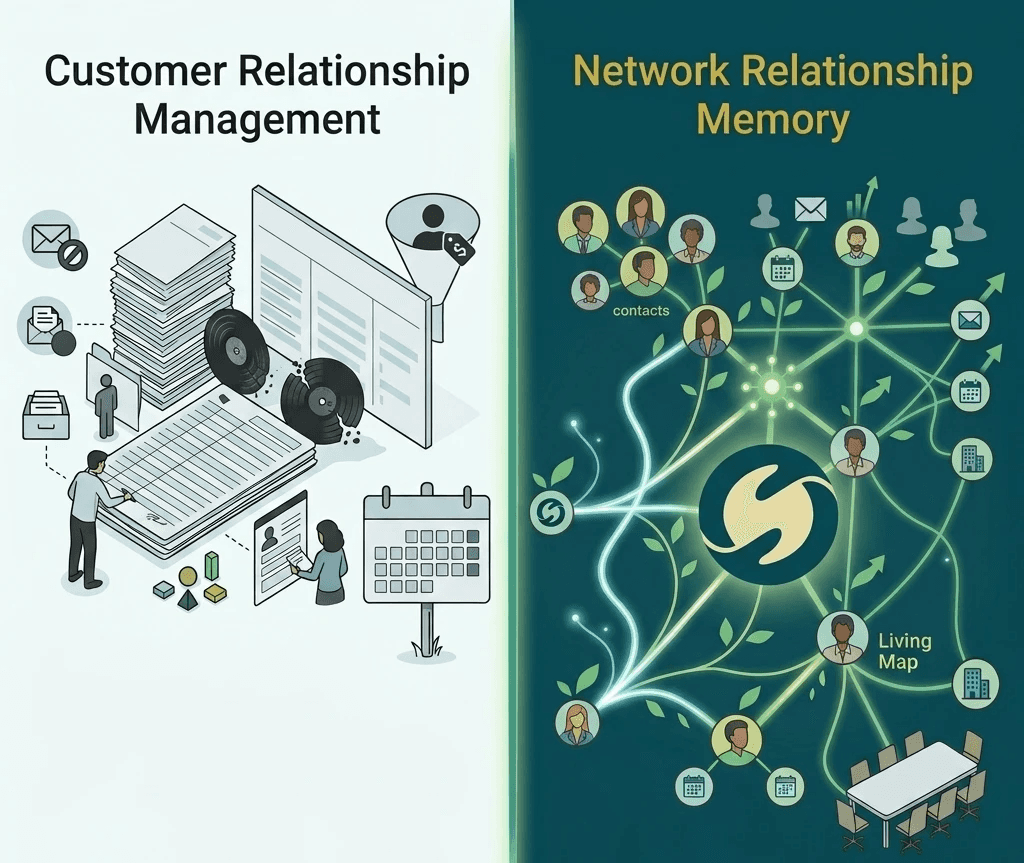
We believe network relationship memory is the next layer of professional infrastructure, the way financial intelligence became one a generation ago. Not automation that sends messages in your name. Not a CRM that demands discipline you do not have and turns people into rows. Something quieter and more fundamental: a memory.
This is what we build at Sumbios. A system that brings everything that matters into one coherent view, so you can finally navigate the dynamic networks you are part of: people change roles, companies pivot, rooms reshape, and the map redraws itself while you work. It reads the intelligence hidden inside the fragments and remembers what human memory was never designed to hold: why you met, what was said, what you share, who can open which door, and who deserves your attention this week.
Three disciplines, held together. Find: ask a question, get the person. Understand: see the paths, the clusters, the bridges, the health of the whole. Remember: let nothing important fade.
Agency and sovereignty is the point
There is a harder principle underneath, and it is the reason Sumbios exists rather than another feature inside an advertising platform.
The network you built is yours. Not the platform's where the contacts happen to sit, not an algorithm's to monetize, not an exporter's to scrape and resell. Yours. You created this asset over decades of dinners, calls, favors, and follow-through. Infrastructure for it has to be built on that premise or it will eventually betray it.
That premise has two halves. Sovereignty is the first: full custody of the asset itself. Your relationships, your history, your data, held under your control, portable, and structurally beyond anyone else's power to sell. Agency is the second: taking back the attention the platforms harvested and spending it intentionally. In O, no feed decides who you see. You decide who to find, who to remember, who to reach, and when, guided by your own goals rather than an advertiser's. Sovereignty without agency is a vault you never open. Agency without sovereignty is freedom on rented land. You need both, and the relationship age belongs to the people who have both.
So we build trusted infrastructure, in the literal sense. Engineered in Europe, private by architecture, no advertising model, and steward-owned, which means structurally incapable of selling your data because no one holds the power to sell it. And on that foundation, the part we care most about: mechanisms for trusted sharing and coordination at scale. Networks compound when they connect, but only with consent, only with visibility you control, only when opening part of your network to a chosen partner is a deliberate act between two sovereign parties rather than a default you never agreed to. Two owned networks, coordinating by intention, can do what no platform-owned network ever will: move trust without spending it. That is how coordination scales in the relationship age. Not through a platform that owns everyone, but through people who own themselves, choosing to connect.
Who this is for
The relationship age has its own professionals: founders and the executives who grow companies, advisors and consultants whose word is their product, investors and the people who move capital, revenue leaders, board members, and the strategic partners who hold rooms together. People responsible for growth, trust, and influence over long horizons. People whose next opportunity already has a name somewhere in their network.
If that is you, the question of the coming decade is simple: will the trust you spent your career building remain a scattered, fading recollection, or become an owned, organized, working asset?
We built O to make it the second one. The network is not the problem. The memory is.
Sumbios O is a network relationship memory for people who have built high-value networks. Membership begins with a private session where we map your network together. Malmö, Sweden.