
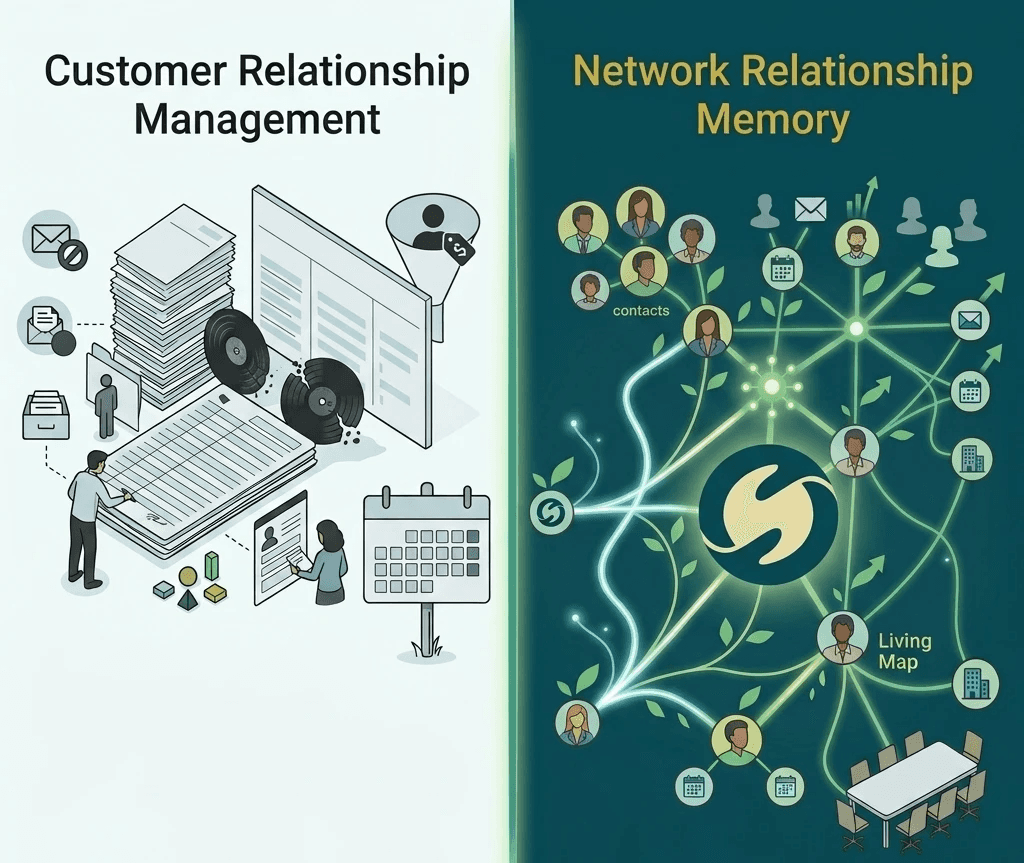
Memory is the infrastructure. Networks are the structure.
Every CRM is built on a 1990s assumption: that a relationship is a record you write down. But records decay. Memory compounds. O isn't an AI layer on top of a CRM; it's the architecture CRMs would have been if they'd been built for human networks instead of sales funnels.
Someone enters your network. You log the meeting. Add a note. Set a reminder. Move a card across a board. The system fills with rows and manual work, all to answer one question: what do I need to do next?
That made sense once. Relationship context was fragile. It lived in inboxes, in your head, in conversations that never made it into any system. People needed a way to keep track.
So they built tracking systems. But over time, the tracking became the job. The record replaced the relationship. And somewhere between the data entry and the dashboard, the actual human connection — the trust, the context, the timing — got lost.
The shift
What comes after CRM isn't a better CRM. It's something fundamentally different.
CRM stands for Customer Relationship Management. A customer is someone you sell to. A relationship is something you log. Management is the work you do to keep it all updated. That's the model we've been living with for 30 years.
Now flip each word.
Network Relationship Memory. A network is everyone you're connected to — not just customers. A relationship is something that grows, not something you file. And memory is something created through each interaction — getting smarter the more you relate, instead of creating more work.
CRM | NRM | |
|---|---|---|
Who | Customer — someone you sell to | Network — everyone you're connected to |
What | Relationship — a record to keep updated | Relationship — something that grows over time |
How | Management — work you have to do | Memory — built through each interaction, gets smarter over time |
That's the shift. From customers to networks, because the value isn't in any single contact, it's in the connections between them. From management to memory, because the system should get better with use, not demand more of your time.
How O remembers
O doesn't store your relationships as rows in a spreadsheet. It stores them as a network memory layer.
Every person, conversation, document, meeting and signal is connected to everything else it relates to. The shape of your network is preserved — not flattened into a list. When you ask O a question, it follows real paths through your actual relationships, not just searching for keywords.
That's why O can tell you: here's who you know at that company, here's the shortest path through a warm introduction, here's what changed last week, and here's the note from the meeting where it all started.
The longer you use it, the more your network knows. The more it knows, the more it does for you.
The Sumbios stack
Layer | What it does |
|---|---|
UI | AI-native interface |
AI companion | Chat · voice · search · activity feed |
Reasoning | Re-ranking · deep research · pathfinding |
Memory ★ | Remembers every relationship across every tool and conversation |
Integrations | Contacts · email · calendar · docs — 700+ apps |
Enrichment | Browser extension · data · signal monitoring |
Memory is the moat because it gets more valuable every day you use it. That's not a feature. It's an asset that grows.
What this means for you
Never lose context on a person again. Know when to reach out before the window closes. Get introduced before your competitor does. Turn your network into something that remembers, thinks, and acts, without the busywork of keeping it updated.
The CRM era recorded interactions. The NRM era remembers networks.
Sumbios O is the first NRM.