Every person has a story. For a long time, I hid behind mine.
I told myself that sharing it would make me vulnerable in ways I wasn’t ready for. That it was too personal, too raw, too far from the polished language of founders, technology and the social media hype and tendency to hide what’s real. But I’ve come to understand something different. The story of my life didn’t just shape me — it gave me an insight, purpose and gift I feel called to bring into the world. And a message I believe needs to be heard. Especially now.
The world is changing right in front of our eyes. Division seems to be accelerating, and the peak of power, inequality, greed and fear-based systems is staring us in the face. At a moment when the most powerful technology we have ever developed is emerging. Yet, I believe a key ingredient is lacking for us to move forward collectively and build a new world we can all thrive in.
That ingredient is a simple and old truth we have too often forgotten.
That at the heart of life lies one thing: connection.
No matter who we are, where we come from, or what we believe in, we are all seeking the same three things:
to connect,
to create,
to grow.
We are one species living under one planet that is asking us to learn how to take care of it and each other.
Everything I’m building comes from that understanding. So it’s time to share how I got here, and why it’s important to where we are heading.
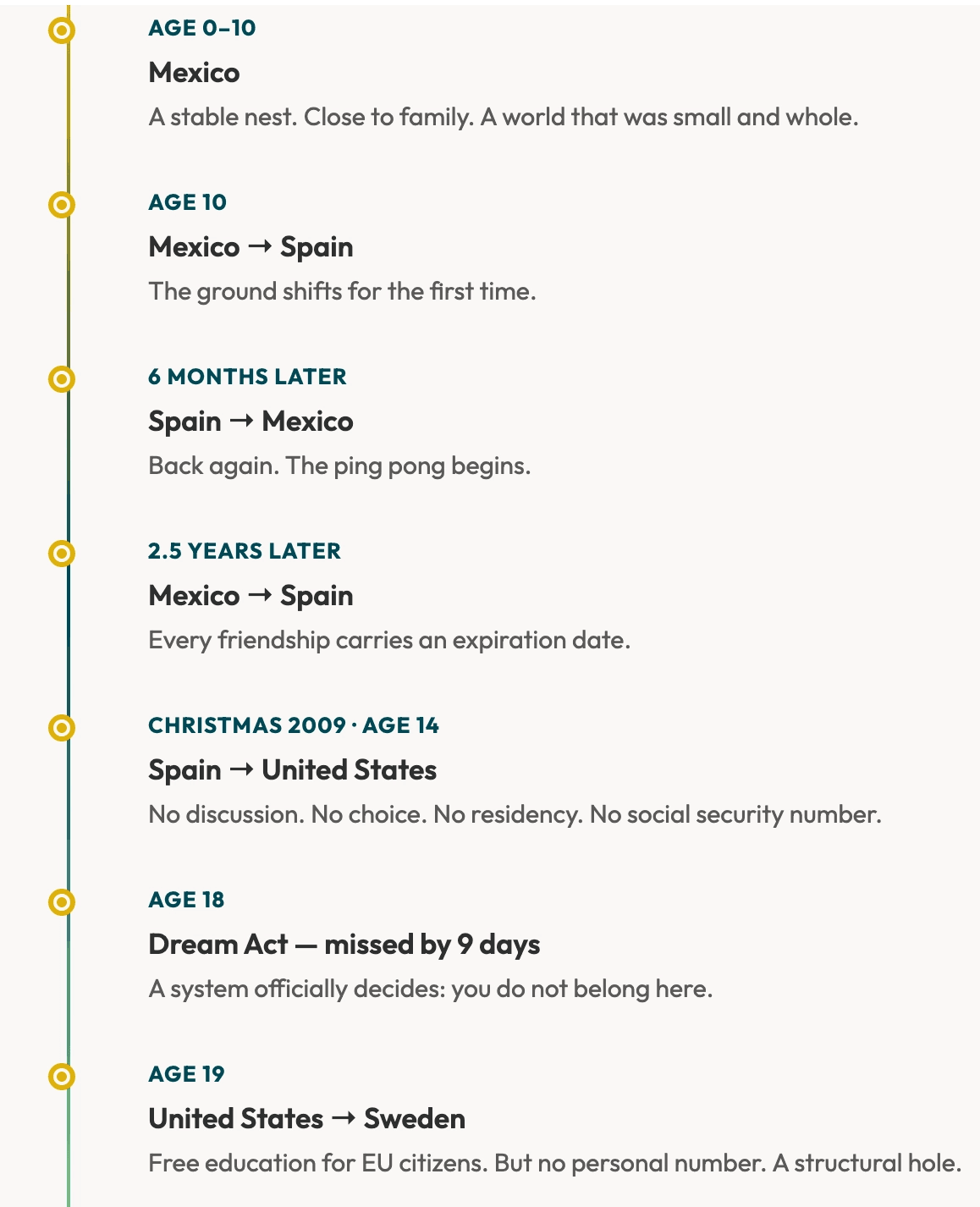
Growing up, I didn’t have what you would call a normal childhood. The closest I had to a stable nest were the first ten years of my life, living in Mexico, close to my family, feeling like I belonged. My world was small and whole. Little did I know that the next fifteen years would be completely different.
At ten, my mother and I moved to Spain. New culture, new norms, new school, new identity. For the first time, the ground beneath me shifted, and it didn’t stop shifting. After 6 months in Spain we went back to Mexico. Then after 2 and half years we went back to Spain again. My life felt like a game of ping pong. I was being tossed between countries before I could ever truly settle. I started to live in a constant feeling of uncertainty.
Continuously asking myself the same question: when would the next move come, and where would I end up? That uncertainty became the texture of my days. I learned to befriend anxiety because it was the only thing that stayed consistent.
During my last year in Spain, I tried to form bonds. But I did so while watching the clock. I knew my time in any one place was limited. Every friendship I built carried an expiration date. It’s a heavy thing to look at someone you care about and know the relationship has a predetermined end. So I started building walls. I learned to guard my heart, bracing for the moment my roots would be pulled up again. I learned to survive, not to thrive.
On Christmas Day, 2009, that moment arrived.
I woke up and found my mother at the computer. She said: we’re moving to the United States. No discussion. No choice.
At fourteen, I entered a whole new country — with no residency, no social security number, and no understanding of what that would mean. At fourteen, you just go to school. You make friends. Life feels almost normal. But I was now officially an “alien”.
I wanted to be an actor. I wanted to be seen. But as an undocumented immigrant, visibility becomes dangerous. By sixteen, the reality of my status was unavoidable. I couldn’t get a normal job. Couldn’t get a driver’s license. I still had friends, still had love, but I didn’t feel included. And I never knew if it would last.
By the time I graduated, I was waiting for the Dream Act. A legal path forward for me to stay in the United States. A place where I had formed an attachment and identity around. A place where the right of the pursuit of happiness was claimed to be a right for all. Yet, I was not part of that all. And when the decisions of the Dream Act finally came, I discovered I’d missed the qualification window.
By nine days.
Nine days decided whether a system recognised me as someone who could stay, belong and keep pursuing my education. Or whether I was just another “alien” in the pool of many.
That was a new kind of displacement. I wasn’t moving between countries anymore — I was being moved out of a country entirely. Living in a society that had officially decided: you do not belong here.
So I worked for a year cleaning private airplanes, and in a fast food place as a 54 year old man to save money and find my new home. Through that process, I applied to universities in Sweden as it’s a free place to study for European citizens, which I am since birth. Thinking I will finally be recognised by a system, be able to get a job, and contribute to society.
I got accepted and moved to Kristianstad Sweden for college. Hoping that returning to Europe would give me what I’d never had — a recognised identity, a personal number, a place in the structure. But European bureaucracy got in the way. I hadn’t lived in Europe as an adult. Hadn’t paid taxes. They couldn’t issue me a number, as I didn’t have health insurance. I could still study, I could still stay, but I was not recognised by the system.
I fell into what I now call a structural hole. A gap between systems where a person simply ceases to exist on paper or doesn’t fit the box of the requirements we have set out to put forth in our systems. Leaving the human behind and labelling them as just another number.
The thing about that structural hole is that it went deep. When you spend the majority of your life without a stable sense of belonging — without a nest, without a single place that says you are welcome here — eventually the weight becomes too much. I made choices I’m not proud of. The loneliness became so heavy that the only way I knew to numb it was to disappear into substance, into fog, into anything that made the feeling stop.
I fell deeper and deeper.
But here is where the story turns. Not with rescue. With recognition.
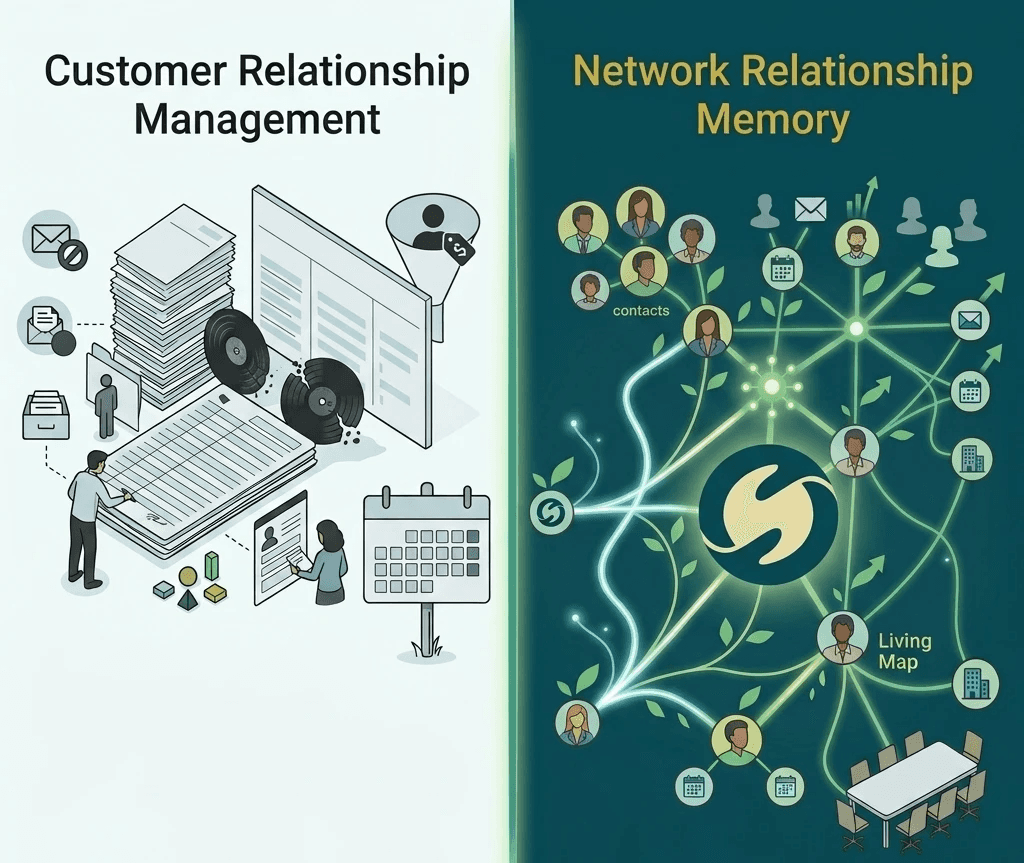
In 2017, at my lowest, I sat down and drew two worlds.
On the left — the world I saw around me and inside me. Disconnection. Not belonging. A world heavy with war, political division, and uncertainty. A world that had been given to me, that I was part of, but that I knew was not the world I wanted to inhabit.
On the right — the world I wanted to help build. People connected back to their hearts. Resources cultivated and shared. Wealth in all its forms — spread and regenerated toward the collective good. I even drew a TED talk called “Unity.”
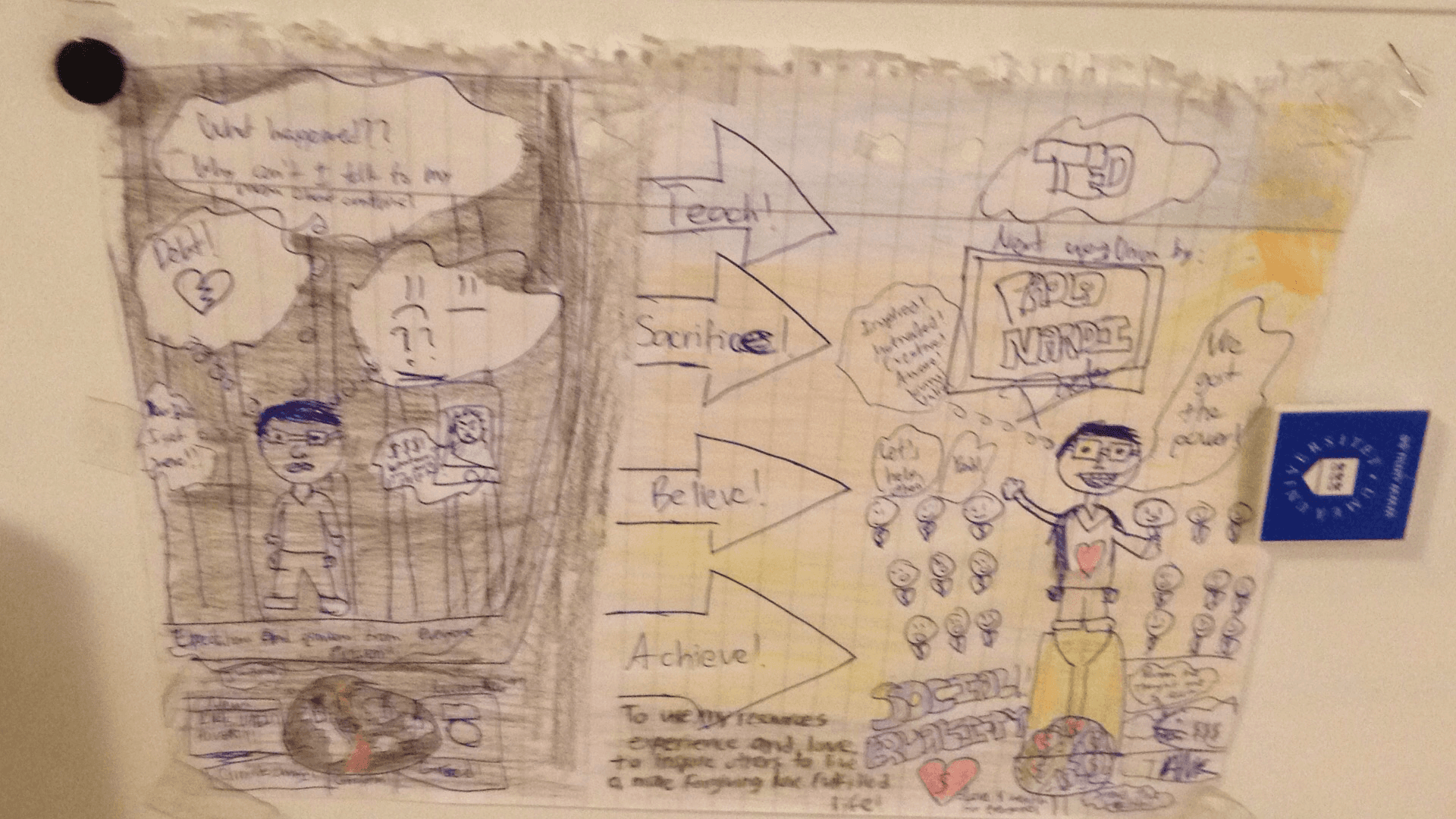
At the bottom, I wrote a mission statement: To use my resources, experience, and love to inspire others to live a more forgiving, love-filled life.
To bring forth this mission, I knew that I had to do something I had never done before. I had to meet myself and make a choice. To die, or to live. Dying felt easy; living was the most difficult part. For to live I needed to meet the version of me that no governments recognised and rejected. My true self. Not the self that needed a passport to prove he existed. But the self that — no matter what any system said — was still connected. Still loved. Still alive.
I had to redefine what belonging actually meant. And find meaning in life.
In that process, I discovered something that changed everything:
belonging is not granted by institutions. It is built — by people, for each other, from the inside out.
I discovered that love was always available. Through the family and friends that showed up. The ones who stayed and helped me. The connection that no bureaucracy could give me and no border could take away.
That insight didn’t just save my life. It gave me a lens to see the world differently. Because when I looked up from my own story, I saw my story reflected everywhere.
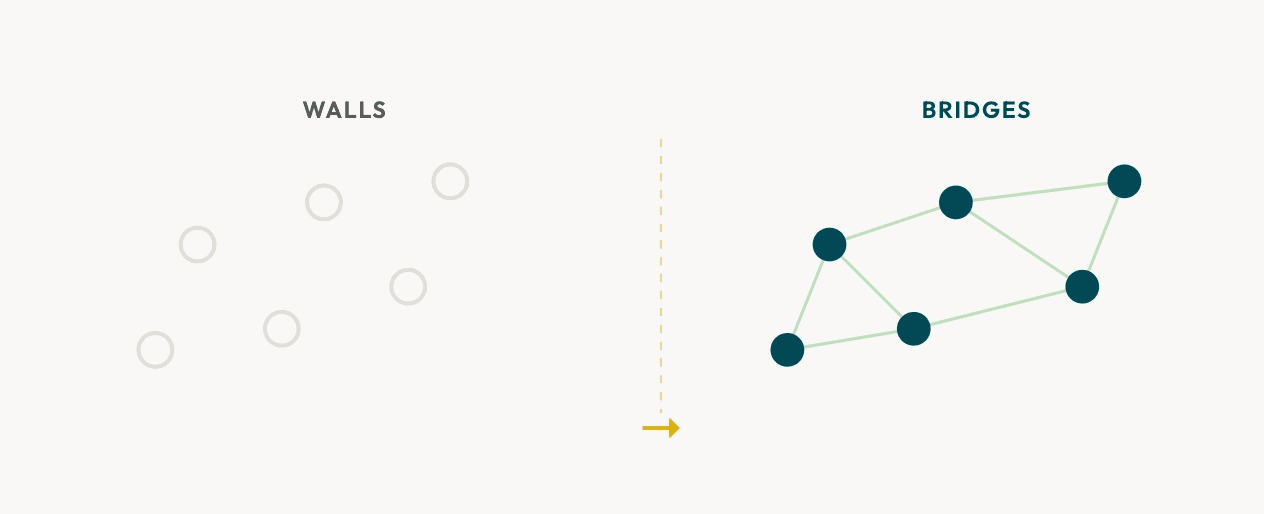
The same structural holes. The same walls where there should be bridges. The same systems designed to sort, separate, and exclude — operating at civilizational scale.
What I had experienced personally, humanity was producing collectively.
Think about it. We have built the most powerful technologies in human history. We can connect anyone to anyone, anywhere, instantly. And yet — loneliness is an epidemic. Trust in institutions is collapsing. Communities are fragmenting. The tools we built for connection are being used for extraction. The platforms designed to bring us together are optimized to keep us apart — because division is more engaging than connection, and attention is more profitable than intention.
This is not an accident. It is architecture. It is what happens when the systems we build are designed without asking the most fundamental question: who are they serving and what future are they creating?
The technologies and systems we have built are feeding upon our deepest insecurities and shadows. Leaving us feeling more empty, disconnected, and divided than ever before. In a moment, when the world is asking us to do the opposite. Nature is calling, our children are waiting for the adults to walk into the room, and our systems are collapsing under the weight of a weak foundation.
A foundation built on fear, greed and separation. A foundation we can no longer keep building upon as what they incentivize is the accumulation of power for the few, and not the flourishing of us all.
Power can no longer be the drive for our countries, leaders and institutions.
🌎 Stewardship, connection, prosperity and dignity need to replace them.
Something which I believe we all feel deep inside, yet we haven’t learned how to articulate and communicate. For to do so, requires that we first come into connection with ourselves and an understanding that at the core of every single one of us there’s a drive for the same three things.
To connect — to belong, to be seen, to be in real relationship.
To create — to contribute, to build, to make something meaningful.
To grow — to learn, to evolve, to become more than we were.
These are not aspirations. They are the basic operating system of being human. When these three things are supported, people thrive. When they are disrupted — by displacement, by exclusion, by systems designed for control and power — people suffer.
I know this because I lived it.
And here is the insight I want to leave with you: technology and artificial intelligence are not neutral in this. It either serves these three human fundamentals, or it disrupts them. There is no middle ground.
Right now, most of what we are building disrupts them. Social media competes with our capacity to connect. Productivity tools extract our creative energy without returning meaning. Growth-hacking culture replaces genuine growth and connection with optimization metrics. We are surrounded by technology and more disconnected than ever. Optimising for outcomes that serve the few and leave us feeling more depleted than ever before.
But it doesn’t have to be this way.
What if we designed technology the way we design ecosystems? Not for extraction — for symbiosis.
In biology, symbiosis is the recognition that life thrives through relationship. No organism survives alone. The tree needs the fungal network. The coral needs the algae. The system is the unit of survival — not the individual.
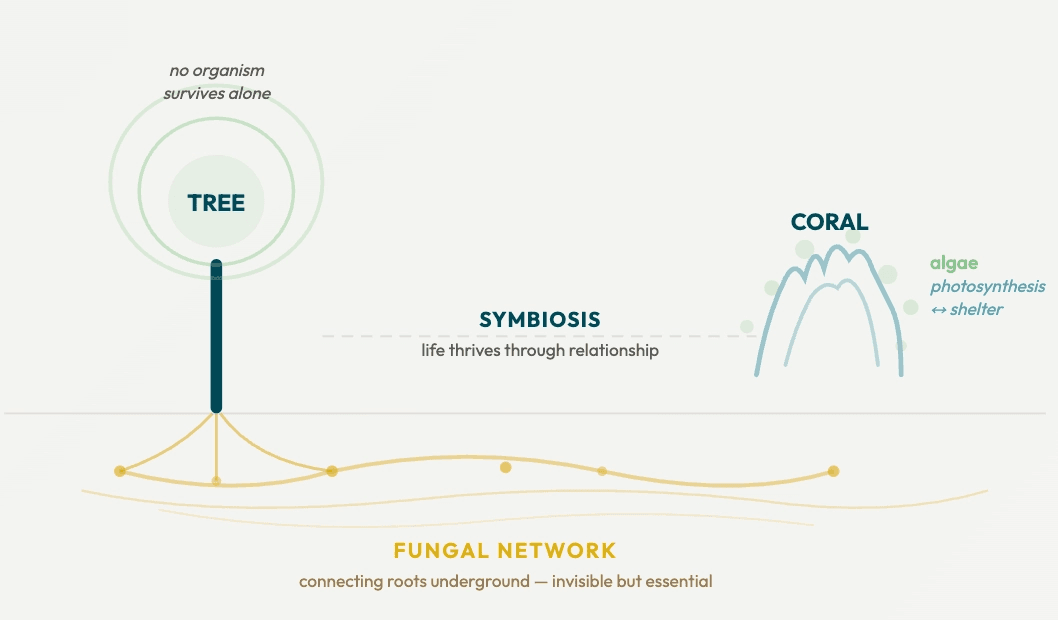
💡 We know this intuitively about nature. We have forgotten it about ourselves.
We have built information networks that concentrate power and lack wisdom. For the greatest wisdom is the understanding that we are one, and the greatest power we have is the knowing that to create is difficult, but to destroy is simple. When the recognition of unity and the honouring of our creative power unite, then symbiosis becomes possible. And that’s why Sumbios exists. As a reminder and a new path forward.
The word Sumbios means “I am life.” Sum (I am), bios (life). Not “I have life.” I am life. It is an ontological claim. We are not separate from the web of connection that makes us possible. We are part of it. And that the Sum of different bios create something more powerful than anyone could do alone. 1+1 = ∞.
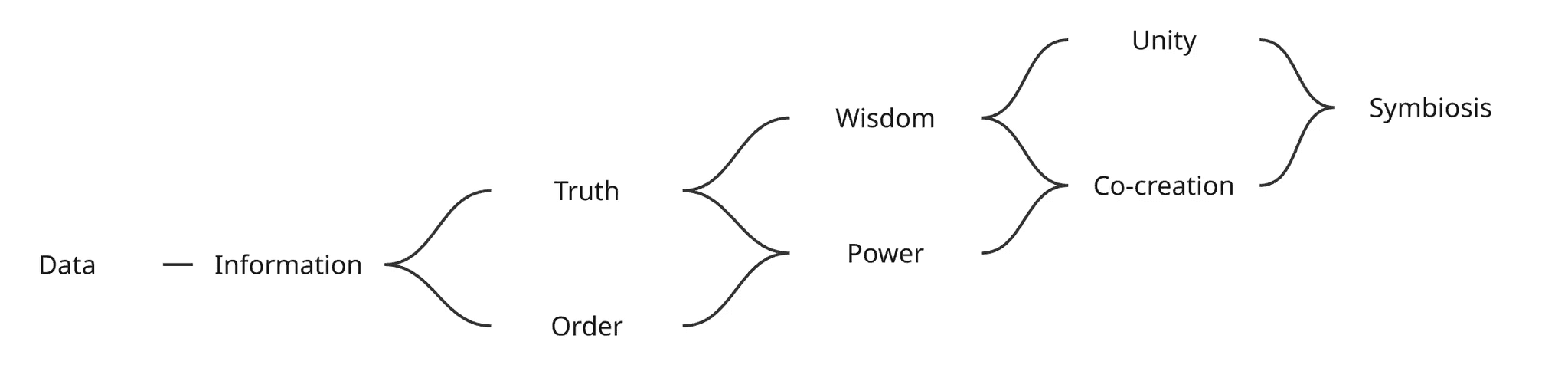
This is what we at Sumbios are building toward, and what we believe we all must remember:
We are life!
Sumbios is not a product, it is a company built around a simple principle: To be in service of life.To steward and use technology and AI to make the hidden connections between people, knowledge and resources visible, accessible, and trustworthy.
To design AI systems with dignity, agency, and privacy at its core — not as features added at the end, but as the foundation everything else stands on. That it should return value to people and the planet, not extract it from them.
This requires a fundamentally different relationship between technology and the people it serves. We call it stewardship.
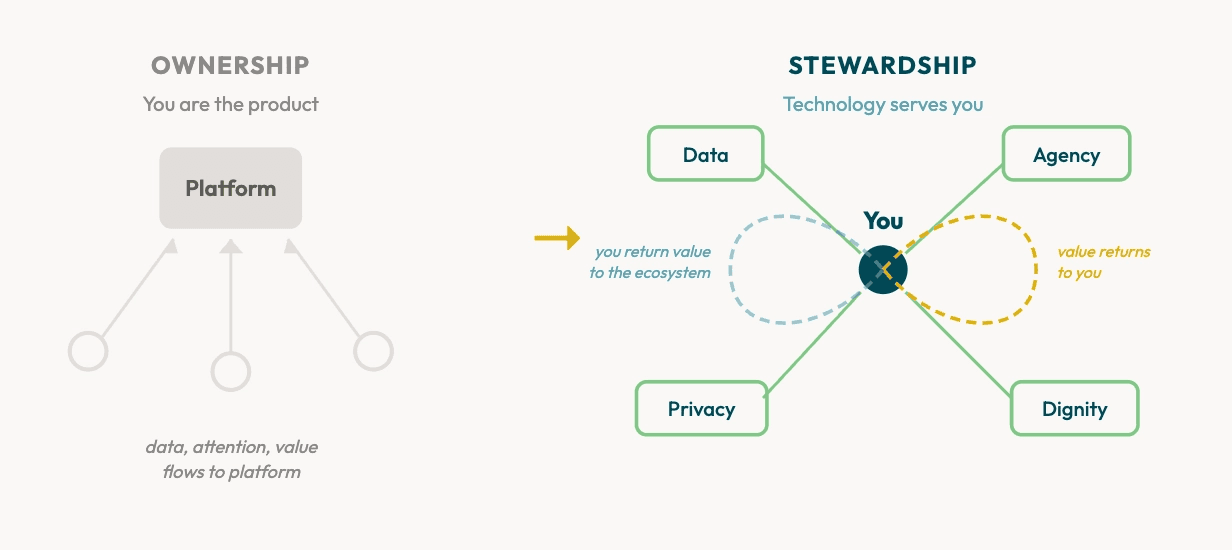
Most technology today operates on an ownership model. The platform owns your data. The algorithm owns your attention. The system decides what you see, who you reach, and what opportunities become visible to you. You are the product.
Stewardship inverts this. In a stewardship model, technology serves at the discretion of the people who use it. Your data remains yours. Your relationships remain yours. The system’s job is not to capture your attention — it is to restore your agency and help you act with intention.
This is not idealism. It is a design choice. And it is one we can make right now.
Privacy is not a feature you add at the end. It is a decision you make at the beginning — and if you wait, the architecture has already decided for you. The same is true for trust. For dignity. For sovereignty. These are not upgrades. They are foundations. And if they are not in the foundation, no amount of iteration will put them there. For the core in which they have been built upon will sooner or later reveal itself.
For far too long, we have built systems on fear, separation, and the concentration of power. Those who control information and truth gain influence. And we have organized entire economies, technologies, and political structures around that principle — creating walls instead of bridges, leaving billions of people to feel the weight of disconnection with no clear path toward something better.
But I believe — because I have lived it — that underneath all of that, we still want the same thing. To be in right relationship with ourselves, with each other, and with the world we share.
We do not crave violence. We are simply too used to surviving. Too accustomed to scarcity. Too trained by systems that taught us to compete for belonging instead of building it together.
Now we are at a choice point.
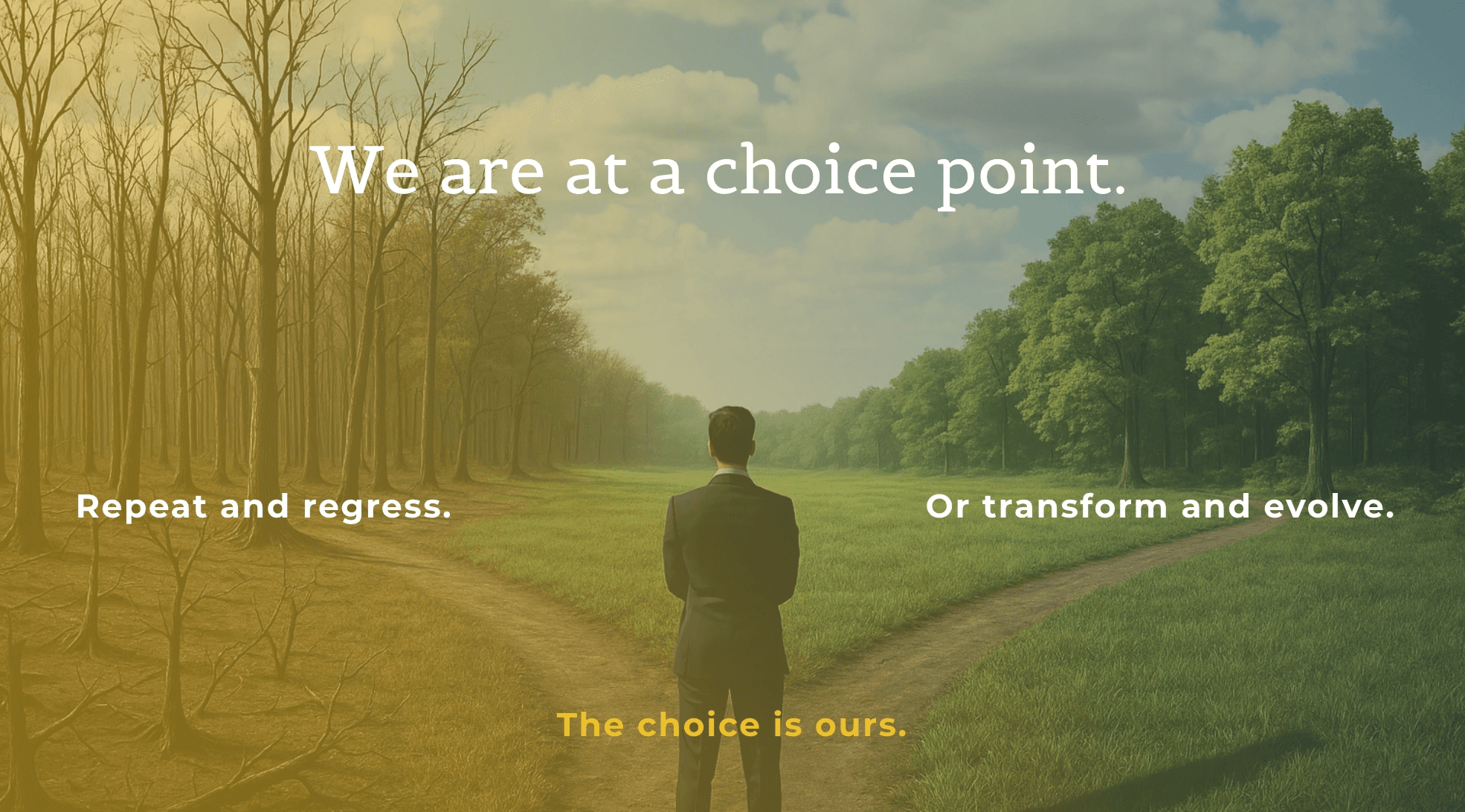
We are more technologically powerful than at any moment in human history. We just went back to the moon and AI is helping us solve problems that were previously impossible! With this comes a fundamental truth and responsibility.
The AI systems we are creating right now will shape how people relate, collaborate, and build for centuries to come. These are not neutral tools. They will be trained upon the values we give them — just as a child learns from the world it is born into.
The question is not how technologically powerful we will become.
The question is: what values will we build it with? And what will we build it for?
Will it serve life — helping human beings connect, create, and grow? Or will it deepen division, concentrate power, and accelerate the suffering we already carry?
I spent fifteen years without a nest. Without a system that recognized me. Without a place that said: you belong.
What I found, at the bottom of all that loss, is that belonging was never something a system could give me. It was something I had to build — with the people who showed up, with the love that was already there, with the part of myself that refused to disappear.
And now I see the same truth at scale. No institution will hand us unity. No platform will deliver it. No algorithm will optimise for it — unless we design it to.
Symbiosis is not a destination. It is a remembrance. A remembrance that we are alive. That together, we are stronger.
Sumbios
1 + 1 = ∞
This is what we have forgotten. And it is what we must remember. At all costs.
If you believe in this future, I ask you to join us, to speak up and to demand something better.
The time is now.
Thank you.
“No one can take our power away if we do not give it to them.”
“Be the change you want to see in the world.”