
By Paolo Nardi, founder of Sumbios. Updated 3 November 2026.
Sumbios O is the AI executive assistant for your professional network. It helps business leaders find the opportunities in their network, nurture the relationships that matter, and unlock new business value from the trust they've already built.
Today we're more digitally connected than ever, yet we understand less about who we know and how we know them. Our relationships live across LinkedIn, email, calendar, WhatsApp and more, and the bigger a network grows, the harder it is to make sense of it or bring it to life. The right person is often already in your network. You just can't find them.
An AI executive assistant for your professional network is built for that gap. It remembers the people you know, prepares you to work with them, and finds who can introduce you to whom. You'll also see the idea called an executive assistant for your network, an AI executive assistant for networking, or a networking assistant. Sumbios O is made by Sumbios in Malmö, Sweden.
The short version
Most of your network has gone quiet, and research shows that the quiet part is where many new opportunities come from. Sumbios O helps you see them.
Sumbios O answers from your own network. You ask in your own words, and it shows where each answer comes from.
It finds the right person and the warmest way in, prepares you for meetings and events, checks a company before a deal, and shows you what has changed for the people you know.
You can share your network with partners you trust, person by person, and switch it off whenever you like. Your network stays yours.
It never sends, books or posts on its own. It prepares you, and you decide.
It's for people whose network is their work: founders, investors, corporate development teams and executives.
Why your network needs an assistant
Business, innovation and ecosystems all grow through relationships. For a company, the reach its people share is probably its biggest growth asset, and today almost none of it gets used.
Part of the reason is that no tool holds the whole relationship. LinkedIn has the profile, your inbox has the thread, your calendar has the meeting, WhatsApp has the last message, and the reason someone mattered is in your head, if it's anywhere. So the work falls on you. You spend half an hour before a meeting digging through old email. You never ask for the introduction because you can't remember who knows the fund. Someone important goes quiet because nothing reminded you.
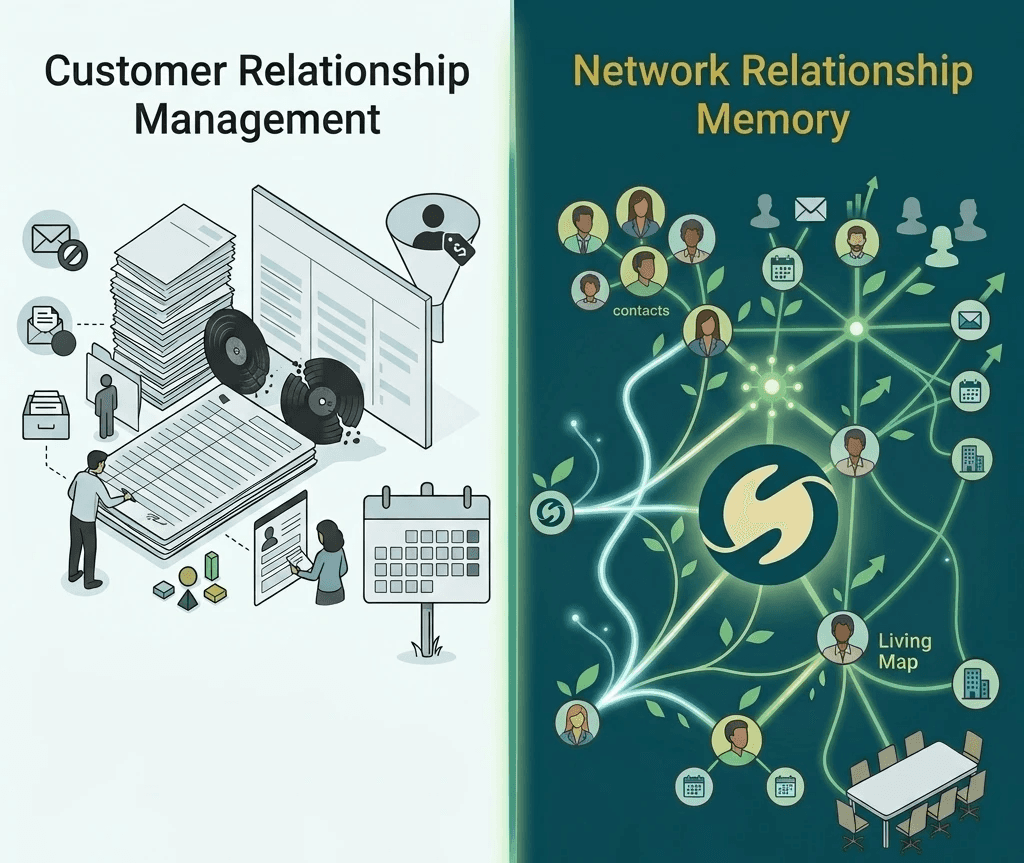
A good executive assistant handles this kind of work for a busy person's calendar and inbox. Sumbios O does it for the people in your professional network. Underneath, Sumbios O keeps a memory of your network, which we call network relationship memory: the people you know, your conversations and your notes about them in one place, so nothing you learn about someone gets lost between apps.
The opportunities hiding in the quiet part of your network
Most of your network is quiet, and that isn't a failing. People can only keep up so many relationships at once. Levin, Walter and Murnighan, writing in MIT Sloan Management Review in 2011, note that adults build up thousands of relationships over a lifetime, but before the internet kept no more than 100 or 200 of them active at any one time.
Take 150 as the middle of that range and the arithmetic is simple:
Connections | Active (about 150) | Quiet |
|---|---|---|
3,000 | 150 | about 95% |
6,000 | 150 | about 97.5% |
10,000 | 150 | about 98.5% |
This is our arithmetic on the research, not a finding of any study.
That quiet part is where a lot of the value sits. Three studies show why.
Acquaintances open more doors than close contacts
From 2015 to 2019, researchers from LinkedIn, MIT, Stanford and Harvard ran a randomized experiment on LinkedIn's "People You May Know" feature. About 20 million people took part. Between them they made about 2 billion new connections and accepted 600,000 new jobs. On average, weaker ties helped people change jobs more than strong ones did. The most useful were moderately weak ties, people you share about 10 mutual connections with. Beyond that, the two of you are close enough to know the same things.
Old contacts are worth more than you'd expect
Levin, Walter and Murnighan asked 224 executives in executive MBA classes in the US and Canada to get advice on a real work project from two people they hadn't spoken to in three years or more. Those dormant contacts were as valuable as current ones, and often more. Their ideas were newer and quicker to get, and the trust and shared outlook had barely faded. In a second group of 116 executives, the tenth person on each executive's list of ten turned out as valuable as the first. The authors estimate that most managers have at least a thousand dormant relationships.
And we reach for the wrong people
When 156 executives picked old contacts to go back to, they chose the people they had spent the most time with, because it felt less awkward. The most valuable reconnections were the opposite: people they had spent less time with or who were more senior, and who were trustworthy and willing to help.
What it adds up to
Two problems. You can't keep up with thousands of people, and when you do reach back, you call the comfortable ones. The opportunities are already in your network. You just can't see them.
That's the job Sumbios O is built for. It remembers everyone you know and how you know them, follows what changes for them, like a new role or a funding round, and lets you ask who in the quiet part of your network matters for what you're working on now.
These studies measured job moves and the value of advice. They didn't measure deals or revenue, and we don't claim they did.
What it does
These are five things people use Sumbios O for, each shown in a short film recorded in the real product. Other people's names and photos are blurred.
1. Prepare you for a meeting
Tell O who you're meeting tomorrow and why. It puts their public profile and their company's recent news next to your own history with them: where you both worked, who you both know, and the last thing you talked about. We estimate that saves 45 to 90 minutes a meeting.
Film: Prep me for tomorrow's room
2. Work an event with you
Give it a conference. It takes the list of speakers, partners and companies, crosses it with your network, and comes back with who to look for, who can introduce you, and what to say.
Film: Prepare for a conference
3. Check a partner before a deal
Before you sign anything, ask O to look into the company. It maps who runs it, who backs it and who it works with, then holds that up against the people you know to find someone who'll give you an honest view. In the film, that turns out to be a person at a sister company nobody would have thought to call.
Film: Due diligence on a partner, with an honest view from people you know
4. Find the warmest way in
Name a fund, a firm or a person you need to reach. O works out which of the people you know are connected to them, ranks each path by how strong the relationships are, and flags the contacts who are too out of touch to ask. If partners have shared their networks with you, it searches those too.
Film: Find your way into a fund
5. Review your week, so people don't go quiet
On a Friday, ask for a review of the week across your conversations, email and calendar: who you met, who's new, and what to carry into next week. Ask who to get back in touch with, and each reason comes from something that changed on their side, like a new role or a funding round, rather than from how long it's been.
Share your network, and keep it yours
No one grows alone. You and a co-founder, a partner or a close colleague each know different people, and between you the right introduction usually exists. Sumbios O lets you share your network with the people you trust, with permission and on your terms.
Sharing works one person at a time. Each friend in O gets their own set of switches, one for your network and others for your Circles and notes, and nothing is shared until you turn a switch on. It also works one way: what you share with someone and what they share with you are two separate choices. If you want a whole team or a fund's partners to see the same thing, you put them in a group and set the access once. And you can turn any switch off whenever you want.
Once a friend shares their network with you, you can search it alongside your own. A person's profile shows which of your friends know them, so finding a warm introduction no longer depends on who you happen to remember to ask.
Sharing lets a friend search your network. It doesn't give your network to them. What a friend shares with you still belongs to them as well: you use it to decide who to ask, and you don't pass it on without their permission.
What it never does
Sumbios O doesn't act on its own. It answers in the app. If you ask it to send an email or a WhatsApp message, or to book a meeting, it shows you what it wrote and waits for your yes. It never posts anything.
We hold that line because relationships are personal. A message that sounds slightly off costs you more with someone you know than with a stranger, so O does the remembering and the legwork and you make the call.
Is it an AI agent?
No. AI agents only know what you tell them, and they take actions for you. CRMs track your customers, but not your whole network. Sumbios O remembers your whole network, follows what changes in it, and works with you.
We used to call this kind of tool a "networking agent", and this page once argued for the term. We dropped it because it promises the wrong thing. Sumbios O is an assistant, not an agent.
How it differs from what you already use
AI executive assistant | Network search | Personal CRM | AI executive assistant for your professional network | |
|---|---|---|---|---|
Examples | Lindy, Superhuman, Fyxer, Motion | Happenstance | Dex, Mesh (formerly Clay) | Sumbios O |
Built around | Your inbox and calendar | Finding people in your connected accounts | A contact list you keep, with reminders | The people you know and your history with them |
What you get | Triage, drafted replies, scheduling | A ranked list of who you know at a company, and the path to them | Reminders to stay in touch, a timeline per contact | Meeting and event prep, checks before a deal, warm paths, a weekly review |
Remembers what was said | Within the inbox | No: Happenstance states that email and message content never reach its servers | What you log, plus synced history | Your connected accounts and your own notes, kept together per person |
Sharing with people you trust | Not the point of these tools | Friends share both ways, and groups pool their members' networks | Within a team workspace | Per friend and per area, one way, and you can switch it off |
Sends for you | Depends on the tool and your settings | No | Not on its own | Only after you read it and say yes |
Happenstance, Dex and Mesh as stated on their own pages, checked 15 October 2026. The first column describes the category as the "best AI executive assistant" lists present it.
An AI executive assistant, the kind of tool on most "best AI executive assistant" lists, looks after your inbox and calendar. These tools are very good at email and scheduling and know little about the people behind them. Pick one if your problem is the inbox.
Happenstance calls itself "a personal CRM you search, not one you maintain". It's quick at finding who you know somewhere and how to reach them, and friends and groups can pool their networks. By design it records who wrote to whom and when, not what was said. Pick it if you mainly need fast search across a large network.
A personal CRM like Dex or Mesh keeps a contact list with reminders and a history for each person. It's built for staying in touch. Pick one if you want a tidy address book that nudges you.
An AI executive assistant for your professional network is for when the people are the work. You meet a lot of them, each meeting matters, and you need to walk in prepared, know who you're dealing with, and find the warm way in without losing your evening to it.
What it needs from you
Your accounts. You connect each one yourself and can disconnect it whenever you like. Sumbios O works with LinkedIn (through a browser extension), Google Workspace or Microsoft 365 for email, calendar and contacts, and WhatsApp. Where an account lets you choose, you pick which calendars or conversations it can use.
Your goals. Tell it what you're working on now, and it shapes its answers around that.
What only you know. A quick note after a meeting, spoken or typed on your phone, is the part no account can supply.
Questions people ask
Is an AI executive assistant for your professional network the same as a personal CRM?
No. A personal CRM keeps the record and reminds you. An AI executive assistant for your professional network does the preparation: it reads across your accounts, adds what's public, and gives you the brief, the path or the review.
Does it replace my CRM?
No. A sales CRM tracks deals and customers. Sumbios O tracks your whole network and your history with it, and on some plans it connects to your CRM.
Is it relationship intelligence software?
Relationship intelligence software such as Affinity is built for a firm's deal team, and Affinity sells no individual plan. Sumbios O is built for one person and the people they know.
Is it a Happenstance alternative?
Yes, if you need more than search. Happenstance is built to find people. Sumbios O is built to remember them and prepare you. The two overlap on warm introductions.
Can I share my network with my team or my partners?
Yes, one friend at a time or as a group, and only the parts you switch on. You can turn sharing off whenever you like.
Is my network still mine if I share it?
Yes. Sharing lets someone search your network. It doesn't hand it over, and nothing is shared until you turn it on.
Can it keep watch for me?
You can ask Sumbios O to keep an eye on topics you choose and bring you what changed, and it shows job and company changes among the people you know. It doesn't contact anyone on your behalf.
Can it be wrong?
Yes. It shows where each answer comes from so you can check, and you should check anything important before you rely on it.
Sources
Rajkumar, K., Saint-Jacques, G., Bojinov, I., Brynjolfsson, E. and Aral, S. (2022). "A causal test of the strength of weak ties." Science. https://www.science.org/doi/10.1126/science.abl4476. Summary: MIT News, 15 September 2022, https://news.mit.edu/2022/weak-ties-linkedin-employment-0915
Levin, D. Z., Walter, J. and Murnighan, J. K. (2011). "The power of reconnection: how dormant ties can surprise you." MIT Sloan Management Review 52(3). https://sloanreview.mit.edu/article/the-power-of-reconnection-how-dormant-ties-can-surprise-you/
Walter, J., Levin, D. Z. and Murnighan, J. K. (2015). "Reconnection choices: selecting the most valuable (vs. most preferred) dormant ties." Organization Science 26(5), 1447 to 1465. https://doi.org/10.1287/orsc.2015.0996
About Sumbios O
Sumbios O is the AI executive assistant for your professional network. It remembers everyone you know across LinkedIn, email, calendar and WhatsApp, finds the right person and the warm way in, and prepares you for every conversation. Nothing goes out in your name until you say yes.
Sumbios O is made by Sumbios, Malmö, Sweden. See how it works · Read the docs